
Material QAl10-4-4 is a copper-based alloy with aluminum as the primary alloying element, classified as a high-strength heat-resistant bronze.
It exhibits high strength and excellent wear resistance, making it suitable for high-strength components such as screws, nuts, bronze bushings, and sealing rings.
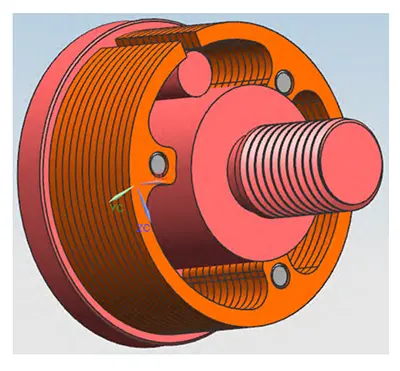
It is widely used in fuel booster pumps and fuel regulator series products for expansion ring sealing components.
During operation, these components are assembled onto the piston shaft.
Upon expansion, their inherent elasticity ensures the outer circumference of the expansion ring seal tightly adheres to the inner bore of the regulator housing without gaps, thereby achieving the throttling function of the fuel regulator.
This paper investigates the manufacturing process of high-precision thin-walled elastic open seals for fuel regulators, addressing issues such as deformation, dimensional deviations in the opening, and excessive light transmission through the outer circumference that occurred during production.
Problem Description
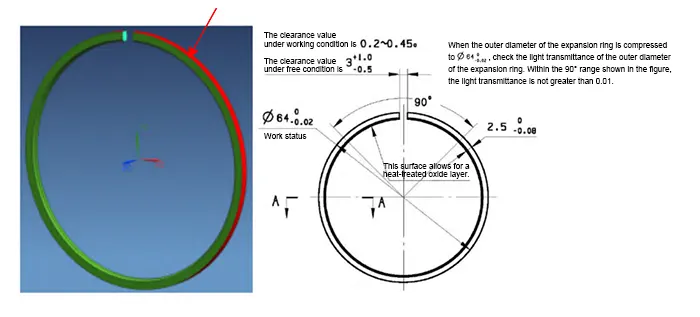
As shown in Figure 1, after heat treatment, the sealing ring exhibits significant and irregular elastic deformation.
Following external grinding, the part’s light transmission rate within a 90° range is 0.01, and the gap dimensions exceed tolerance limits.
Cause Analysis
Material and Structural Analysis
QAl10-4-4 is a copper-aluminum-nickel-iron four-element heat-resistant complex aluminum bronze.
Nickel significantly enhances the bronze’s strength, hardness, thermal stability, and corrosion resistance, with its most notable characteristic being excellent wear resistance.
Aluminum bronze (QAl10-4-4) possesses sufficient hardness in its hot-rolled state (raw material).
However, numerous defects in the raw material—including internal stresses, microstructure, grain size, eutectoid content, and dispersion—impair its machinability.
This leads to issues such as deformation, cracking, and wear during machining.
To improve machinability, solution treatment and aging heat treatment are essential to achieve the desired microstructure and mechanical properties.
However, with the seal ring’s axial thickness of 2mm and wall thickness of 2.5mm, mounting it in a fixture for solution treatment and aging causes significant and uneven deformation due to internal stresses.
Process Analysis
1. Process Analysis of Opening Dimension Deviation
The manufacturing processes causing opening dimension deviation (Figure 2) include heat treatment and slitting.
After heat treatment, the opening dimension is required to be 3.5±0.5mm.
During heat treatment, due to internal stresses within the parts, significant and uneven deformation occurs.
This results in poor consistency of the opening dimensions and a tendency for large deviations.

2. Process Analysis of Outer Circle Light Transmission Deviation
The process responsible for the outer circle light transmission deviation defect in this part is the outer circle grinding operation.
A conventional external cylindrical grinder is used for grinding the outer circle, with the part processing schematic shown in Figure 3.
Key factors influencing the grinding process include the machining sequence, allowance control, clamping method, grinding wheel type, and feed rate.
① The process sequence is illustrated in Figure 4.
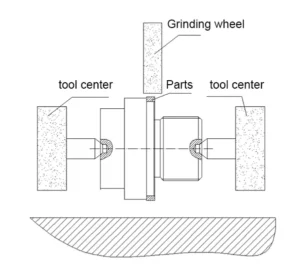
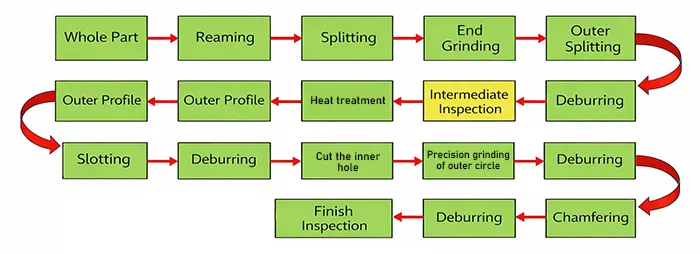
As shown in the flowchart, the critical process involves precision grinding the outer diameter using the inner bore as the reference.
The part is mounted on a mandrel and processed using a two-center method on the machine tool.
At this stage, the inner bore reference is ensured by wire cutting, with a surface roughness requirement of Ra 0.8 μm, a tolerance requirement of ±0.015 mm, and no taper or ovality requirements for the inner bore.
From a precision grinding perspective, ensuring the high accuracy of the outer diameter hinges critically on the precision and consistency of the reference.
Poor reference accuracy and inconsistent reference conditions directly compromise the outer diameter’s taper and ovality control, leading to the outer diameter’s light transmission tolerance exceeding the 0.01 mm specification.
②Clamping Method A rational, stable, and reliable clamping method is crucial for part machining quality.
As this part features an open structure unlike typical closed solid components, the key challenge lies in securely mounting it onto the mandrel via its reference bore for stable and reliable grinding.
Without precision fixtures, precision grinding of the outer diameter resulted in the part’s light transmission tolerance exceeding the 0.01 requirement.
③ Grinding Wheel Type: This part is made of aluminum bronze QAl10-4-4 with a hardness of HB200–240.
During grinding, the grinding wheel exhibits minimal wear.
A PA80H8VS3A chromium alumina wheel was used for external grinding. If the wheel is not dressed promptly during grinding, it can become clogged with chips.
Additionally, the relatively soft wheel increases the interaction force between the wheel and the part, leading to the seal ring’s light transmission exceeding the tolerance.
④ Feed Rate for Finishing Grinding:
A higher feed rate during external finishing grinding generates greater instantaneous stress and causes more part deformation, making it difficult to meet the 0.01mm light transmission tolerance requirement.
Conversely, a smaller feed rate generates relatively lower stresses and reduces part deformation.
However, this approach lowers machining efficiency, increases labor intensity, and compromises process economy.
Therefore, selecting and establishing a reasonable feed rate is crucial.
Currently, there are no feed rate control requirements for precision grinding of external diameters, creating a potential cause for exceeding the 0.01mm tolerance limit for external diameter light transmission.
Improvement Measures and Verification
Correction for Out-of-Tolerance Opening Dimensions
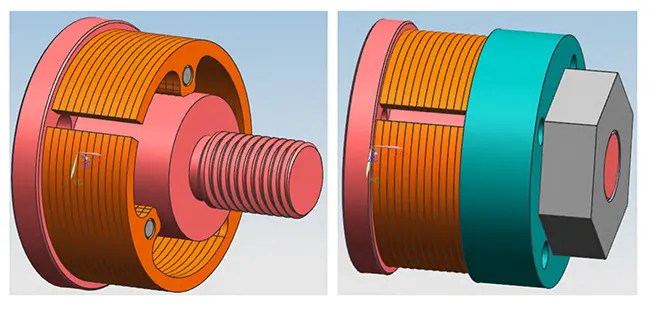
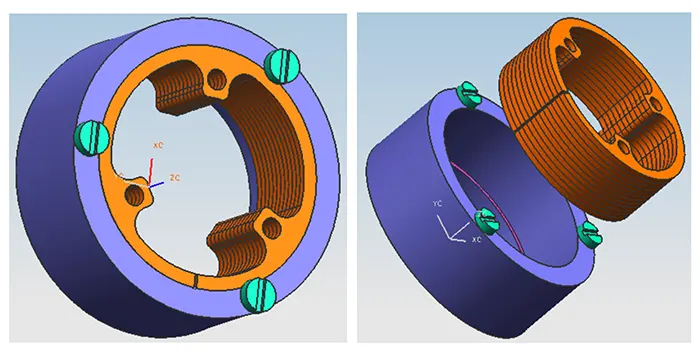
By analyzing the causes of out-of-tolerance opening dimensions and optimizing the heat treatment fixture, the sealing rings are expanded and fitted over the fixture’s locating shaft.
Orientation is achieved using the three process locating holes on the sealing ring, ensuring consistent direction at the openings of multiple sealing ring parts.
Simultaneously, locating pins were installed between the opening and the mandrel.
These pins tightly contact the inner wall of the part opening and the mandrel, preventing the opening from sinking due to lack of support during heat treatment.
Parts were secured using nuts. Comparisons of the optimized and original fixtures are shown in Figures 5 and 6.
This approach reduced deformation at the opening during heat treatment and eliminated dimensional deviations.
Improvements for Excessive Light Transmission in External Circles
1. Process Flow Enhancements
Due to the part’s thin wall thickness (2.5mm) and short overall length (2mm), multiple parts are clamped together for machining after heat treatment to enhance processing efficiency.
Process Flow: The reference bore before precision grinding of the outer diameter was machined directly via wire cutting.
Its dimensional accuracy, taper, and surface roughness failed to meet precision grinding requirements.
To minimize the reference bore’s impact on the ground outer diameter, a honing operation was added after wire-cutting the bore.
Both wire-cutting and honing were performed on an assembly line. without disassembling the fixture.
The internal bore cylindricity is required to be 0.005 mm.
A honing fixture for the internal bore is also designed to ensure all precision requirements of the reference bore are met, guaranteeing part dimensional consistency.
This provides a stable and reliable reference for the precision grinding process, ensuring part quality.
The improved process flow is shown in Figure 7, and the honing fixture for the internal bore is shown in Figure 8.

2. Determination of Outer Circle Grinding Fixturing Method
Due to the elastic deformation of the part’s thin-walled opening, post-grinding must ensure both light transmission requirements and the opening dimensions under compression.
Traditional single-mandrel, two-center fixturing methods cannot meet this part’s machining requirements.
Analysis revealed that the part’s reference hole is too short and the part is open-ended, preventing direct locating and clamping.
Attempts to secure the part using end-face clamping failed to guarantee the post-grinding opening dimensions.
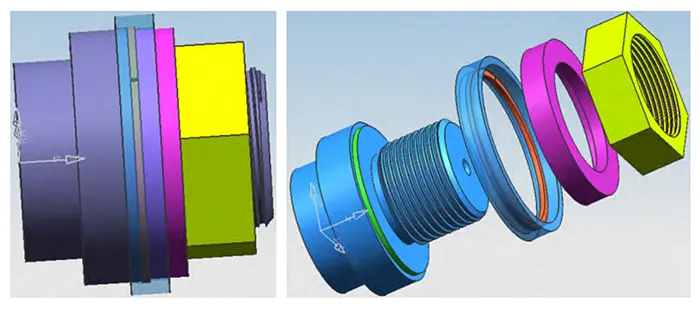
Since the opening dimensions must be qualified after the part is loaded into the fixture, a locating sleeve was fabricated to ensure the opening dimensions.
After loading the mandrel, end-face clamping was performed.
The locating sleeve was then removed before grinding the outer diameter. The fixture is shown in Figure 9.
3. Grinding Wheel Selection
As this component is an aluminum bronze non-ferrous metal part, based on experience and relevant literature review, combined with the material properties of QAl10-4-4 and confirmed through on-site testing, the abrasive type, hardness, bonding agent, and grit size of the grinding wheel were determined.
① Grinding Wheel Abrasive Selection QAl10-4-4 is a thermally strong, complex aluminum bronze alloy containing copper, aluminum, nickel, and iron.
It exhibits excellent wear resistance.
Since no wheel replacement is required during rough and finish grinding of the outer diameter, a silicon carbide abrasive wheel was selected.
② Grinding wheel hardness selection:
Hardness selection primarily depends on the workpiece material, grinding efficiency, and surface finish quality.
Harder wheels are preferred for grinding soft materials, while softer wheels are chosen for hard materials.
The QAl10-4-4 material has moderate hardness.
A harder grinding wheel should be selected during grinding to ensure self-sharpening properties, allowing abrasive grains to shed easily and maintain consistent sharpness.
③ Grinding Wheel Binder Selection
The binder refers to the material bonding the abrasive grains within the wheel.
Different linear speeds, hardness levels, and structural compositions require distinct binder formulations and designations.
During grinding, material shedding can clog the wheel’s pores, impairing cutting performance.
Therefore, a ceramic binder with high porosity should be selected.
④ Selection of Grinding Wheel Grit Size.
For this component, the outer diameter roughness is Ra 0.4 μm, and the outer diameter clearance is 0.01 mm.
Therefore, grinding wheels with grit sizes of #80 and #100 were selected for testing.
The surface roughness achieved with the #100 grit wheel proved superior to that of the #80 grit wheel.
4. Grinding Wheel Feed Rate
External cylindrical grinding comprises rough grinding and finish grinding stages.
Controlling the feed rate is the most critical parameter during the grinding process.
Excessive feed causes part deformation, while insufficient feed reduces machining efficiency and increases labor intensity.
Selecting a reasonable and economical feed rate is particularly important.
During rough grinding, both machining efficiency and Grinding Wheel Feed Rate Relatively increased feed rates are used during rough grinding to remove the grinding allowance.
During finish grinding, a small feed rate is adopted to ensure the stability of the final part dimensions, surface roughness, and light transmittance.
The process is divided into 8 passes, with specific grinding parameters shown
| Machining Stage | Pass Number | Feed Rate (mm) |
|---|---|---|
| Rough Outer Diameter Grinding Stage | 1 | 0.04 |
| Rough Outer Diameter Grinding Stage | 2 | 0.03 |
| Rough Outer Diameter Grinding Stage | 3 | 0.02 |
| Rough Outer Diameter Grinding Stage | 4 | 0.01 |
| Rough Outer Diameter Grinding Stage | 5 | 0.008 |
| Finish Outer Diameter Grinding Stage | 6 | 0.005 |
| Finish Outer Diameter Grinding Stage | 7 | 0.003 |
| Finish Outer Diameter Grinding Stage | 8 | 0.001 |
Through processing verification, improvements were made to heat treatment fixtures, process flows, external grinding clamping methods, grinding wheel types, and grinding parameters.
Heat treatment fixtures were optimized to reduce deformation, while increasing the honed bore improved the precision grinding reference.
An optimal clamping method for precision external grinding was designed.
A GC100P5V7A silicon carbide grinding wheel replaced the original PA80H8VS3A chromium alumina grinding wheel for external grinding.
Grinding parameters were optimized, resulting in stable part quality post-grinding.
The aperture dimensions and external light transmission met the 0.01mm tolerance requirement.
Conclusion
To address defects in high-precision thin-walled elastic open-type sealing rings, including deformation, excessive gap dimensions, and out-of-tolerance outer diameter light transmission,
This paper proposes process flow improvements, machining methods, clamping techniques, grinding wheel modifications, and optimized grinding parameters through material property analysis and process evaluation.
These measures were validated through machining trials, successfully resolving deformation issues, dimensional deviations in the opening, and excessive light transmission in the outer diameter of high-precision thin-walled elastic open-end sealing rings.
Additionally, the grinding characteristics of this material were elucidated, providing engineering practice data for the company and its subsidiaries to process similar components.