
Locating Elements
The positioning of a product within a fixture is achieved through contact or engagement between the product’s locating reference surfaces and the working surfaces of the fixture’s locating elements.
Here, the locating elements are classified according to their method of positioning.
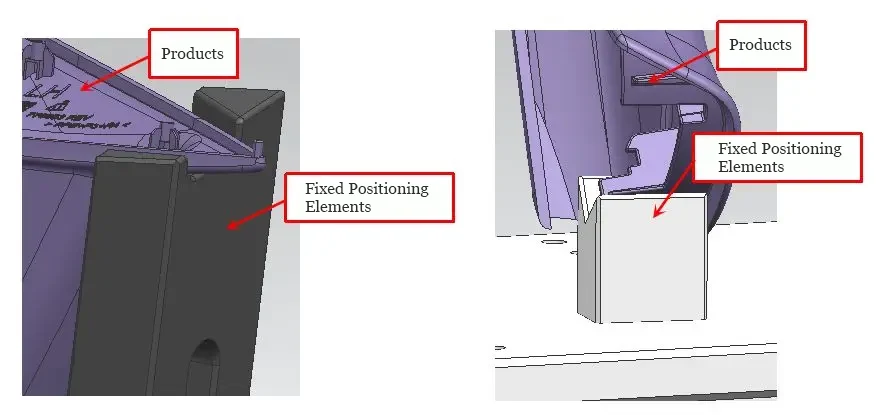
Fixed positioning elements
Once installed in the fixture, these positioning elements are generally not removed or adjusted.
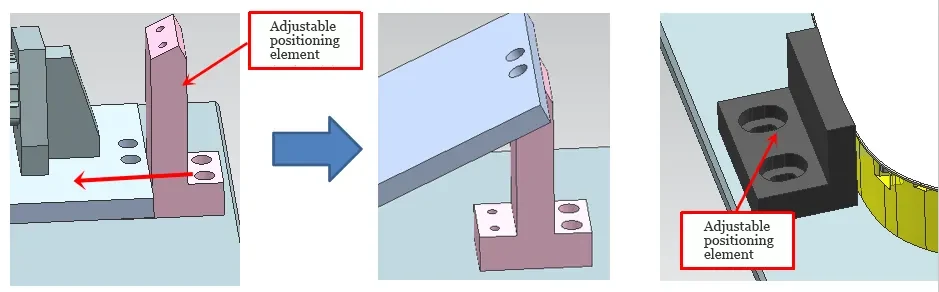
Adjustable Positioning Element
(A positioning element on a fixture where the position of the locating point can be adjusted)
Floating Positioning Elements
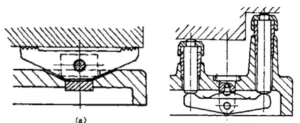
These are positioning elements in which the position of the positioning points automatically adjusts to changes in the position of the product’s reference plane during the positioning process.
The figure below shows a two-point floating positioning element.
While a floating positioning element may make contact with the product at two or more points, in practice only one fixed support point is effective, restricting only one degree of freedom of the product.
Auxiliary Positioning Element
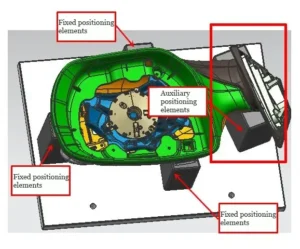
(Used to improve the stability of the product when placed in the fixture, but does not serve as the primary positioning element)
As shown in the figure below, the three fixed positioning elements serve as the primary positioning elements.
However, due to the product’s structure, the area circled in red tilts downward when the product is placed in the fixture, resulting in unstable assembly.
Therefore, an auxiliary positioning element has been added.
Clamping Jig
(A tool used to position and clamp a product based on its shape)
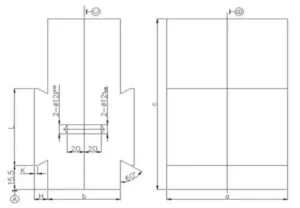
Design Considerations:
1. This type of clamping die is primarily used on a vise, and its length can be cut to size as needed.
2. Additional auxiliary positioning devices may be incorporated into the clamping die; the die is typically attached via welding.
3. The above is a schematic diagram; the structural dimensions of the mold cavity are determined by specific requirements.
4. A 12-mm diameter locating pin should be tightly fitted at an appropriate position on the moving die, and the locating hole at the corresponding position on the fixed die should have a sliding fit with the locating pin.
5. When designing the cavity, the outer contour should be offset and enlarged by 0.1 mm based on the outer surface of the non-shrink blank drawing.
Drilling and Milling Fixtures
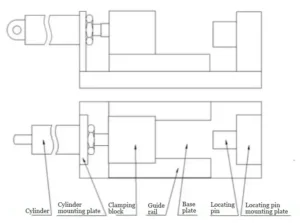
Design Considerations:
1. If necessary, auxiliary positioning devices may be incorporated into the fixed core and its mounting plate.
2. The figure above is a simplified structural diagram; the actual design must be adapted to the specific product structure.
3. The cylinder should be selected based on the product’s size and the forces encountered during machining.
CNC, Instrument Chucks
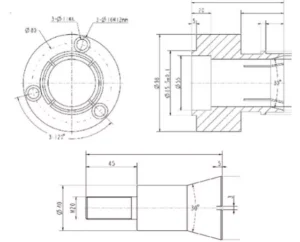
Design Notes:
1. Dimensions not shown in the figure above are determined based on the actual internal bore dimensions of the product.
2. When manufacturing the outer circle that makes contact with the product’s internal bore for positioning, a 0.5 mm allowance must be left on each side.
The part should then be mounted on a CNC machine and precision-turned to size to prevent deformation and eccentricity caused by the quenching process.
3. Spring steel is recommended for the assembly section, and 45# steel for the tie rod section.
4. The M20 thread on the tie rod is a standard thread; this thread size may be adjusted based on actual requirements.
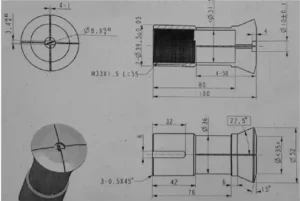
Design Notes:
1. The diagram above is for reference only; assembly dimensions and structure are subject to the actual product’s dimensions and design.
2. Use 45# steel, quenched.
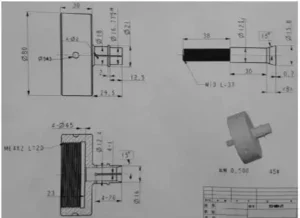
Design Notes:
1. The diagram above is for reference only; actual dimensions depend on the internal bore dimensions and structure of the product.
2. When machining the outer diameter that makes contact with the product’s internal bore for positioning, a 0.5 mm allowance must be left on each side.
The part should then be mounted on a dial indicator lathe and precision-turned to the final dimensions to prevent deformation and eccentricity caused by the quenching process.
3. Use 45# steel and perform a quenching treatment.
Gas and Water Testing Fixtures
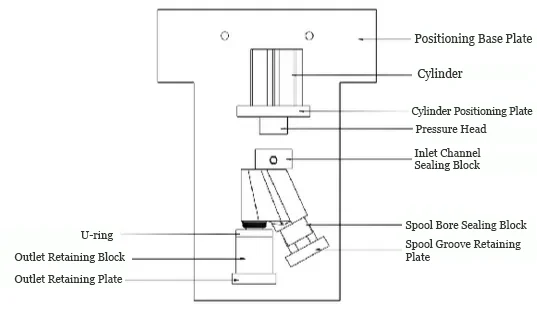
Design Considerations:
1. The figure above is a reference diagram for the leak testing fixture. The specific structure must be designed based on the actual product design.
The approach is to seal the product as simply as possible, filling the area to be tested with gas to verify its seal integrity.
2. The size of the cylinder can be adjusted according to the actual size of the product.
It is also necessary to ensure that the cylinder stroke allows for convenient loading and unloading of the product.
3. Sealing surfaces in contact with the product should generally use materials with good compressibility, such as Urethane rubber or NBR O-rings.
Additionally, if any positioning blocks come into contact with the product’s exterior surface, use white plastic blocks whenever possible and cover them with a cotton cloth during operation to prevent scratching the product’s surface.
4. The product’s orientation must be considered during design to prevent internal gas leaks from becoming trapped inside the product’s cavity, which could lead to false test results.
Trimming and Punching Fixtures
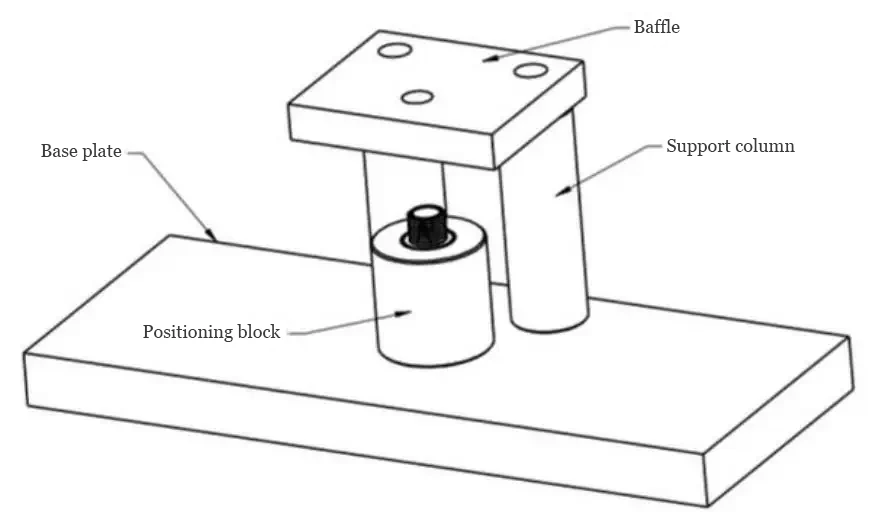
Design Considerations:
1. The base plate is designed to facilitate secure mounting on the punch press worktable.
2. The positioning blocks are designed to secure the product; their specific structure is tailored to the product’s actual characteristics, with the center point positioned to allow for convenient and safe loading and unloading of the product.
3. The guide plate is designed to facilitate the release of the product from the punch.
4. The support columns serve to secure the guide plate.
5. The mounting positions and dimensions of the above components may be designed according to the product’s actual characteristics.
Welding Fixtures
Welding fixtures primarily serve to secure the positions of components within a welded assembly and control their relative dimensions.
Their structure consists mainly of positioning blocks, which must be designed according to the actual structure of the product.
It is important to note that when the product is placed on the welding fixture, no sealed spaces should be created between the fixture and the product.
This prevents excessive pressure from building up in these sealed spaces during the welding heating process, which could affect the dimensions of the components after welding.
Polishing Jigs
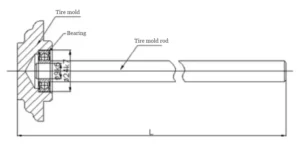
Design Notes:
1. The specific dimensions of the mold are determined by the product design.
2. We recommend using the first three mold rods; dimensions not otherwise specified are in mm.
3. Use 45# steel.
Assembly Fixtures
Design Guidelines:
1. Positioning methods for structural components or reference positioning elements: Precision positioning must include at least two pins and one screw; non-precision positioning should not use pins and generally requires at least two screws.
2. Positioning between jig components generally uses M6 or M8 screws and 5 mm pins, except in special cases; each bolt must be secured with a spring washer and a flat washer; threaded holes in plastic and aluminum plates must be fitted with threaded inserts.
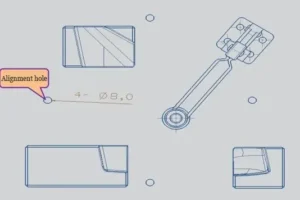
3. The jig must include at least two positioning holes for connection to the worktable; the diameter of these positioning holes is 8 mm.
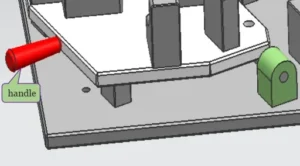
4. Rotating parts on the equipment must be equipped with handles to facilitate operation by personnel.
5. Deburr the edges of the workpiece and round off any sharp edges.
Pad Printing, Laser Engraving Fixtures
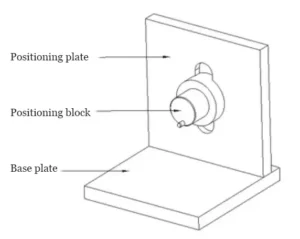
Design Considerations:
Design the positioning structure of the jig based on the actual engraving requirements of the product.
Ensure ease of product handling and protection of the product’s appearance.
Where possible, use non-metallic materials such as white glue for positioning blocks and auxiliary positioning devices that come into contact with the product.