
In fields such as aerospace and precision tooling, the demands for machining accuracy of complex components are becoming increasingly stringent.
During the motion of a CNC machine tool feed system, the friction in the guideway-lead screw drive chain exhibits strong nonlinear characteristics.
When the motion changes from stationary to moving, the system undergoes a transition between static and dynamic friction.
This transition causes a sudden change in tracking error and produces concave-convex errors at the quadrant transition points of circular contours. These errors severely degrade the surface quality of the parts.
Adaptive feed control technology adjusts compensation parameters in real time to achieve precise suppression of friction disturbances.
This approach provides an effective technical solution for high-precision machining of complex parts.
Overview of Feed Accuracy
In a four-axis horizontal machining center, Y-axis direction reversal generates friction disturbances that produce a distinct concave peak in roundness tests. These disturbances ultimately create tool marks on the workpiece surface.
Complex tribological interactions between the guideway pair and the lead screw-nut pair cause the nonlinear behavior of friction.
Its magnitude is influenced by the coupled effects of various factors, including contact pressure, relative velocity, lubrication conditions, and temperature.
Traditional fixed-parameter controllers struggle to cope with such time-varying disturbances.
Adaptive Feed Control Technology
Improved Friction Models and Parameter Adaptation
Accurate friction compensation in feed systems depends on establishing a dynamic model that precisely describes the transition between static and dynamic friction.
The improved model separates the friction force into two components: a velocity-dependent static component and an acceleration-dependent dynamic component.
The static friction force is described by the Stribeck function, expressed as:

In the equation:
- Fc is the Coulomb friction force;
- Fs is the maximum static friction force;
- vs is the Stribeck velocity;
- v is the feed rate.
- Bv is the viscous friction coefficient;
- e is the tracking error.
The dynamic friction component is compensated by applying velocity pulses, and the compensation amount is adaptively adjusted based on the acceleration state of the feed axis.
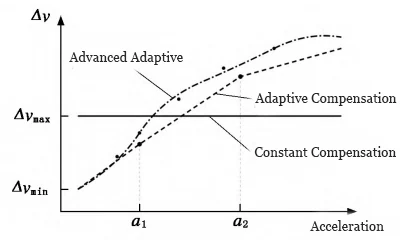
The Siemens 840D system provides three adaptive compensation strategies, as shown in Figure 1.
The constant compensation mode uses additional pulses of fixed amplitude and is suitable for operating conditions with stable friction characteristics.
The adaptive compensation mode forms a piecewise linear compensation law through three acceleration control points.
The high-order adaptive mode supports four characteristic curves, each containing nine control points, enabling precise approximation of complex friction characteristics.
Design of a Dual-Region Sliding Mode Control Strategy
To robustly suppress residual disturbances caused by parameter estimation errors, a sliding mode control method is employed.
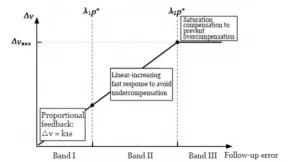
The dual-region control strategy divides the compensation region based on the specific magnitude of the tracking error.
Figure 2 shows that when the error falls below the threshold λ₁p* (where λ₁ represents the first-interval coefficient and p* denotes the position tracking error reference), proportional feedback regulates the system.
The control strategy also applies an additional pulse amplitude Δv = k1e (where k1 is the proportional feedback gain coefficient) to support smooth system convergence.
Within the interval λ₁p* ≤ e ≤ λ₂p* (where λ₁ represents the first-interval coefficient and p* denotes the position tracking error threshold reference), the system increases the compensation amplitude gradually following a linear law.
When the error exceeds λ₂p* (where λ₂ defines the second-interval coefficient for the error saturation boundary), the system limits the compensation amplitude by applying saturation at the specified value to prevent undercompensation.

In the equation:
km is the servo drive gain;
σ₀ is the stiffness coefficient of the brown body.
εmax is the maximum deformation deviation.
The time parameters of the compensation pulses determine the dynamic characteristics of the sliding mode boundary layer.
The X-axis is set to 0.012 s and the Y-axis to 0.015 s in the roundness test, forming a time window that matches the mechanical response time constant of the feed axis.
This alignment indicates that the time window corresponds well to the dynamic characteristics of the feed system.
The structure of the Lyapunov function allows demonstration that the closed-loop position tracking system of this feed axis achieves asymptotic stability.
Technical Application Validation and Effect Analysis
Comparative Validation of Trajectory Tracking Accuracy
A roundness test method evaluated the dynamic performance of the X-axis and Y-axis of a four-axis horizontal machining center.
This approach verified the effectiveness of adaptive feed control technology in improving trajectory tracking accuracy.
The test program was set with an arc radius of 20 mm and a feed rate of 2000 mm/min.
The CNC system’s built-in roundness test function collected positional deviation data for each axis in real time after cycling the interpolation motion 10 times.
Table 1 compares the trajectory tracking accuracy before and after friction compensation.
| Test Item | X-Axis Before Compensation | X-Axis After Compensation | Y-Axis Before Compensation | Y-Axis After Compensation |
|---|---|---|---|---|
| Overshoot and Backlash Error / μm | Significant | Eliminated | Significant | Eliminated |
| Roundness Error ΔR / μm | 6.18 | 1.45 | 7.92 | 1.68 |
| Compensation Parameter MD32500 | 0 | 1 | 0 | 1 |
| Additional Acceleration Feedforward Value MD32520 | Not set | 30 | Not set | 60 |
| Timeout Period MD32540 / s | Not set | 0.012 | Not set | 0.015 |
Table 1. Comparison of Trajectory Tracking Accuracy Before and After Friction Compensation
Table 1 shows that the roundness test curve before compensation exhibits a sharp dip at the quadrant transition point.
A sudden change in friction at the moment of direction reversal causes this dip in the error and triggers a peak in the tracking error.
The pre-compensation roundness error on the X-axis is 6.18 μm, while that on the Y-axis is 7.92 μm.
The larger error on the Y-axis reflects more severe friction disturbances under load conditions.
After enabling adaptive friction compensation, parameters were adjusted iteratively to match the compensation pulse amplitude with the actual friction disturbance.
Case Study: Machining of a Typical Complex Part
A parameter configuration scheme validated through roundness testing guided the application of adaptive feed control technology to arc contour machining on an actual part.
When the compensation function was not enabled, the workpiece exhibited noticeable tool-mark defects at arc transition points.
Table 2 shows that the inter-quadrant concavity error observed in the roundness test directly corresponds to this surface quality issue.
| Evaluation Indicator | Before Compensation | After Compensation |
|---|---|---|
| Arc Transition Marks | Clearly visible | Basically eliminated |
| Surface Quality | Unqualified | Significantly improved |
| Precision Compliance | Unable to meet requirements | Fully meets requirements |
| Existing Equipment Condition | Not applicable | No mechanical overhaul required |
| Parameter Adjustment Method | Not applicable | Software parameter optimization |
| Implementation Cost | High | Low |
Table 2. Comparison of Machining Quality for Complex Parts
Table 2 compares machining quality and validates the feasibility of adaptive feed control in machining complex parts.
Parameter tuning at the CNC system software level can effectively compensate for disturbances caused by friction forces.
No large-scale maintenance of mechanical components such as guideways and lead screws was required.
This result fully demonstrates that the improved friction model accurately describes the transition between static and dynamic friction, establishing a practical foundation for the widespread application of adaptive feed control in aerospace and precision mold manufacturing.
Conclusion
An improved friction model and a two-zone sliding mode control strategy enable adaptive feed control technology to effectively address path-tracking accuracy issues in the machining of complex parts.
Arc contour machining on a four-axis horizontal machining center verifies the effectiveness of this technology.
It significantly suppresses quadrant-crossing concavity errors, and the machining process achieves the required precision standards.
As CNC machine tools age, the issue of deteriorating mechanical performance becomes increasingly prominent.
Maintaining machine tool dynamic characteristics becomes possible through adaptive feed control technology, which also extends equipment service life.
It delivers practical application value by supporting the intelligent transformation of the manufacturing industry.