
If bearing manufacturing were likened to a relay race, turning would be the first leg. It must not only shape the bearing rings but also leave “just the right amount” of machining allowance for subsequent heat treatment and grinding operations.
If the turning allowance is too large, grinding becomes time-consuming and labor-intensive, and material consumption increases;
if it is too small, even slight deformation during heat treatment could render the part scrap.
In short: The quality of the turning process directly determines the quality, efficiency, and scrap rate of the grinding process.
Role of Turning in the Complete Bearing Manufacturing Process
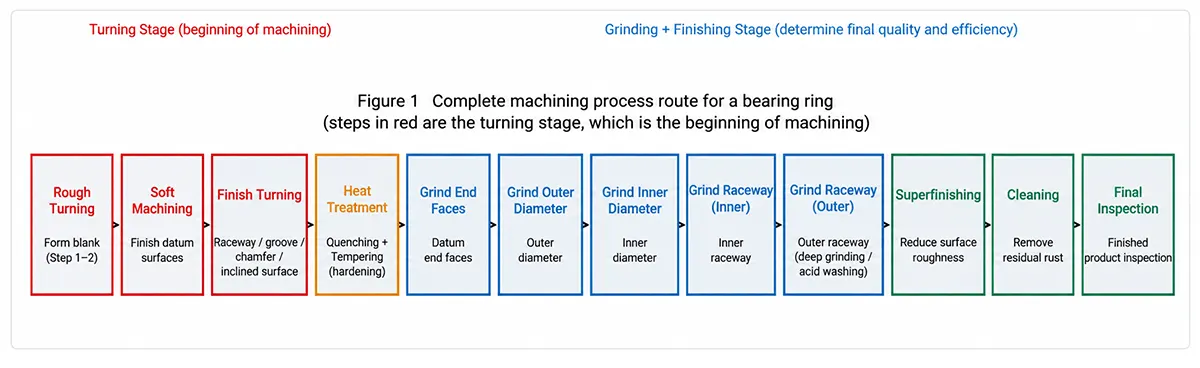
From blank to finished product, bearing rings typically undergo more than a dozen processes, including rough turning, soft grinding, finish turning, heat treatment, hard grinding (grinding of end faces, outer diameters, inner diameters, and raceways), superfinishing, cleaning, and final inspection.
Turning is the first step in the process chain and is primarily responsible for form-cutting operations.
It has two core objectives:
Forming
To give the ring or part a geometric profile that conforms to the drawing, including end faces, inner and outer diameters, raceways, chamfers, oil grooves, and dust-proof grooves;
Allowance
To provide a reasonable allowance for subsequent heat treatment deformation and grinding operations—neither too large nor too small.
The turned ring serves as the positioning reference for subsequent processes and also has a transitional impact on the quality of the final product.
For example, errors such as end face runout, roundness of inner and outer diameters, and groove positioning will be carried over to the grinding and even assembly stages.
Key Considerations in the Manufacturing Process Chain
Heat treatment separates the turning stage (blanking → rough grinding → finish turning) from the grinding stage. Heat treatment deformation will consume part of the turning allowance;
therefore, sufficient allowance for deformation must be “reserved” in advance during turning, while the grinding allowance should not be set too large.
Bearing Ring Blanks: The “Starting Point” for Turning
Blank manufacturing is the first step in ring processing, and the technical level of blank production directly determines steel utilization and machining costs before heat treatment.
Advanced blank manufacturing processes ensure a rational distribution of metal flow lines and a dense microstructure, thereby extending bearing service life.
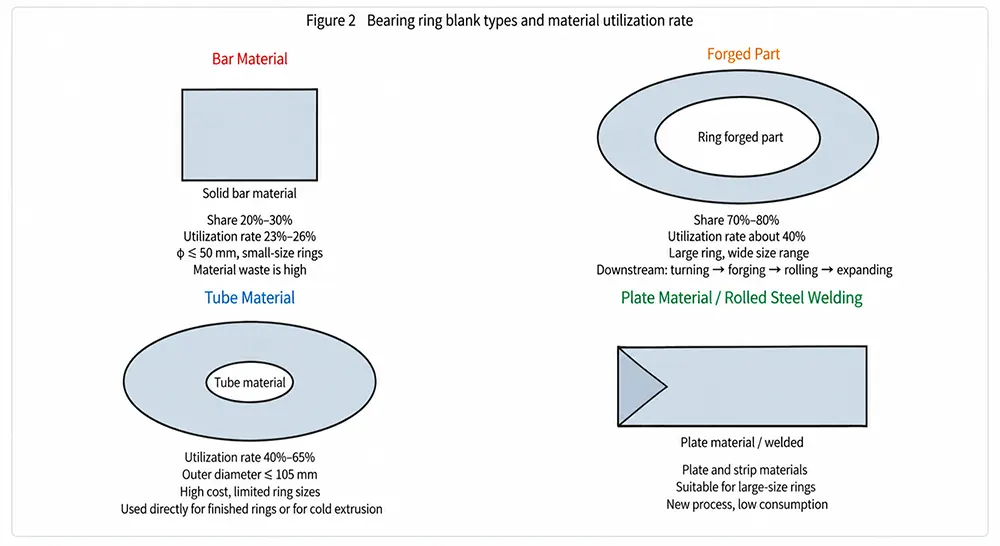
Currently, there are four main types of bearing ring blanks commonly used in China.
Bar Stock
Bar stock is a long, rod-shaped steel product produced by heating steel ingots and then subjecting them to billet rolling or forging.
It is generally used for small rings with a diameter of 50 mm or less. In domestic production, it accounts for approximately 20% to 30% of total output, with a material utilization rate of 23% to 26%.
It can be machined directly by turning or used as a cold-extrusion blank and is available in both annealed and unannealed conditions.
The advantages of bar stock include simple preparation and flexible changeovers, but its material utilization rate is relatively low.
Forgings (Largest Share)
Forged blanks account for the largest share in bearing manufacturing, at approximately 70% to 80%, with a material utilization rate of about 40%.
The main manufacturing processes include heating, blanking, forging, upsetting, trimming, inspection, annealing, and cleaning.
Forged blanks are mostly ring-shaped, with a wide range of dimensions;
they feature a dense microstructure and good flow line distribution, making them suitable for high-volume production.
The disadvantages are the lengthy production process and the high demands placed on forging equipment.
Tube Stock
Tube stock is produced by heating and rolling steel billets or steel bars and can be used directly for turning rings or as material for cold extrusion.
It offers a high material utilization rate, ranging from 40% to 65%;
However, due to material specification limitations, it is primarily used for rings with diameters of ≤105 mm, and its cost is relatively high.
Welding of Sheet Metal and Structural Steel
Sheet metal is produced by heating and rolling steel billets into steel plates or strips of a specific thickness, which are then annealed and used for stamping bearing rings.
In recent years, a new process involving the welding of structural steel blanks has been adopted for large and extra-large bearings.
The goal is to reduce material consumption and shorten production cycles, and this represents an important direction in the development of blanks for extra-large bearings.
Core Principles for Material Selection
Batch size, size range, precision grade, and cost targets collectively determine the type of blank.
For large batches of small- to medium-sized rings, forgings are the preferred choice; for small batches or extremely small sizes, bar stock may be used;
for diameters ≤ 105 mm where material utilization is a priority, tube stock may be selected; and for extra-large sizes, sheet metal stamping or welded structural steel should be considered.
Turning Process Methods: Concentrated-Operation Method vs. Decentralized-Operation Method
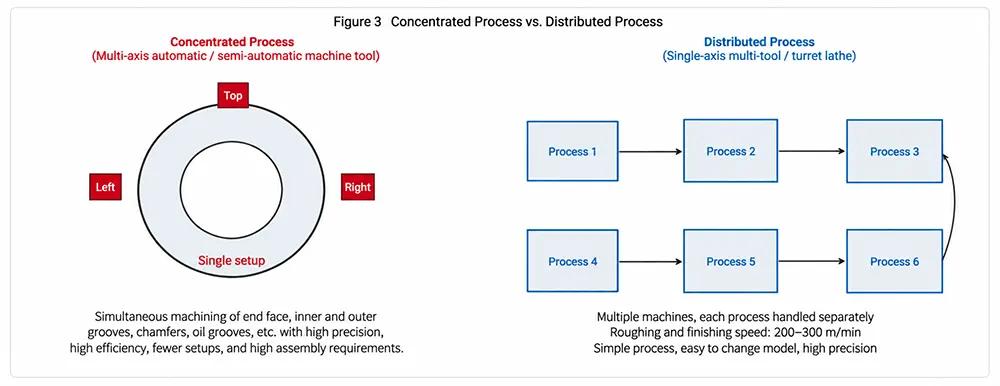
Process methods for turning rings can be broadly divided into two categories: the concentrated-operation method and the decentralized-operation method.
The choice between these methods depends on the production batch size, equipment capabilities, the complexity of the rings, and the required precision.
Concentrated-Process Method
The centralized machining method is typically performed on multi-axis semi-automatic or fully automatic lathes and is further divided into two categories: “full process centralization” and “partial process centralization.”
After a single setup, the workpiece can undergo sequential machining of various surfaces—including outer diameters, inner bores, end faces, grooves/raceways, fillets, chamfers, oil grooves, flanges, ramps, and dust-proof grooves—at different axes of the machine tool or on a tool changer.
1. Main Advantages:
Most or all turning operations are completed in a single clamping cycle, reducing the number of clamping and positioning operations, auxiliary labor hours, and positional errors between machined surfaces;
High machining accuracy and production efficiency;
2–3 medium- and small-sized rings can be turned in a single cycle for batch production;
Shortens the production process, reduces intermediate storage, loading/unloading, and transportation steps, and facilitates production organization and management;
It facilitates automation and high-volume production, thereby reducing production costs.
2. Main Disadvantages:
High precision requirements for machine tools, cutting tools, fixtures, auxiliary equipment, and workpiece blanks;
Changing models on multi-tool, multi-station equipment is cumbersome, and adjustments are difficult and time-consuming;
Requires machine tools with high power, high rigidity, and high precision, and demands a high level of technical skill from operators.
Distributed-Process Method
The distributed-process method typically uses single-spindle, multi-tool semi-automatic lathes and turret lathes.
Only one or a few surfaces are machined per setup, and a single bearing ring requires several lathes to complete all turning surfaces.
This is the method currently adopted by most domestic bearing manufacturers and is particularly suitable for forged blanks, complex shapes, varying sizes, and inconsistent batch sizes.
1. Main Advantages:
High-efficiency, specialized machine tools with high rigidity and powerful drive systems can be used, achieving cutting speeds of 200–300 m/min (currently about 150 m/min in China);
Specialized machine tools, tooling, and fixtures are simple and economical, easy to adjust and maintain, and facilitate model changes;
It does not require a high level of technical skill from operators, is easy to operate, and facilitates single-machine automation;
High adaptability to raw blanks; multiple varieties, small batches, and large-sized rings can be machined on CNC machines.
2. Main Disadvantages:
Long process sequences, multiple setups and positioning operations, significant positioning errors, and relatively low machining accuracy;
Relatively increased production floor space, auxiliary processes, and consumption of manpower and material resources;
Long downtime for storage, transportation, inspection, and loading/unloading between processes.
Selection Guidelines
High-volume, few varieties, high precision: Prioritize the centralized processing method;
multiple varieties, small to medium batches, complex large-diameter rings: Prioritize the decentralized processing method or CNC turning.
In actual production, these two methods are often used in combination.
Structural Elements of Bearing Races: Which Surfaces Need to Be Machined During Turning?
Although a bearing race may appear to be a simple “ring,” there are actually quite a few structural elements that must be controlled during the turning process.
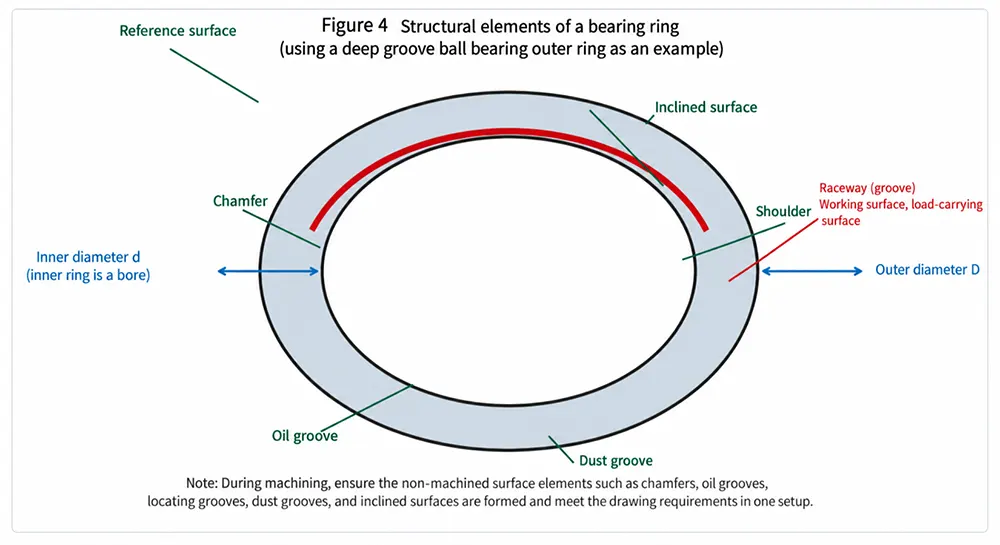
Taking the outer race of a deep-groove ball bearing as an example, the main surfaces involved in the turning process include:
End Face:
Serves as the positioning reference for subsequent processes and directly affects end face runout after assembly;
Inner Diameter d / Outer Diameter D: Relate to mating parts and determine whether the fit is interference or clearance;
Raceway:
The core working surface that supports the rolling elements;
It has the most stringent requirements for roundness, curvature, and positioning;
Chamfer:
Removes burrs, facilitates assembly, and prevents stress concentration;
Oil Groove:
Lubrication channel;
Retaining flanges/ramps:
Restrict the axial position of rolling elements and guide lubricant;
Dust groove / Stop groove:
Used for installing seals or stop devices.
Among these, the raceway is the most critical working surface of the bearing rings;
Its geometric shape, positional accuracy, and surface quality directly determine the bearing’s load-carrying capacity, noise, vibration, and service life.
During turning, the raceway must not only be shaped but also leave a uniform and appropriate amount of material allowance for subsequent raceway grinding.