
Aircraft propellers generate thrust through high-speed rotation, enabling aircraft to move forward. This thrust originates from the aerodynamic lift produced by rotating propeller blades.
Consequently, propeller blades play a critical role in both the propeller assembly and overall aircraft performance. Their structural integrity directly influences operational safety.
During high-speed rotation, propeller blades experience centrifugal forces, torque-induced bending forces, tensile bending forces, aerodynamic twisting moments, and centrifugal twisting moments.
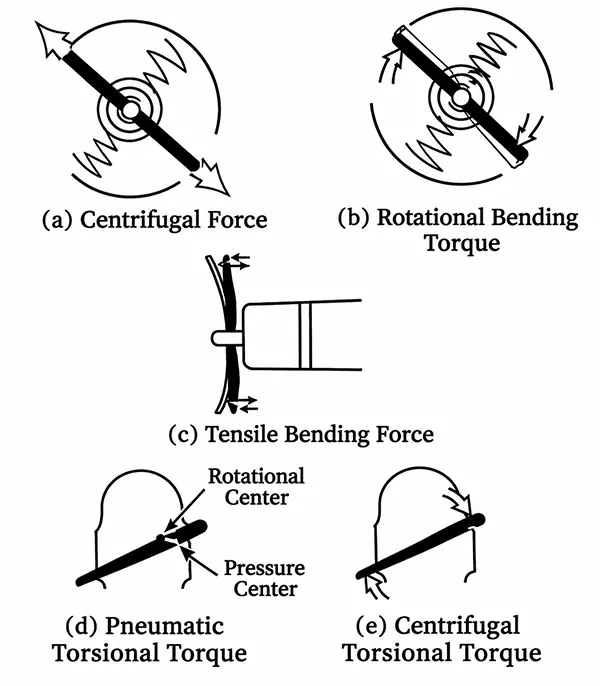
These substantial forces act continuously throughout flight. Any localized stress concentration may initiate cracks that propagate rapidly under repeated mechanical loading.
Severe crack propagation can eventually cause blade fracture and loss of aircraft propulsion. Such failures may lead to catastrophic aviation accidents.
Structural Analysis of Aircraft Propeller Blades
The aircraft propeller examined in this study consists of one hub and three aluminum alloy blades. Each blade contains two main structural sections: the blade body and blade root.
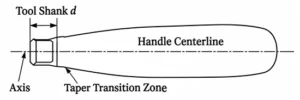
The blade body remains fully exposed during propeller operation and experiences particularly demanding environmental conditions. The blade tip operates closest to the ground and frequently encounters airborne sand and gravel.
Although these particles appear relatively small, their impact energy increases significantly at high blade rotational speeds. Repeated impacts can cause severe surface damage.
Therefore, the blade body requires high surface hardness and effective corrosion resistance. These properties help protect the underlying aluminum alloy against environmental damage.
The blade body also receives paint after surface treatment. Its surface coating must therefore provide strong paint adhesion.
The propeller hub secures each blade through its root section. Sealing rings tightly enclose the blade root within the hub assembly.
This arrangement protects the blade root from direct impacts by external objects. However, the blade root repeatedly rotates relative to the hub during pitch adjustment.
Such movement generates substantial friction between the blade root and sealing rings. Therefore, the blade root requires an exceptionally smooth surface.
Maintaining adequate surface smoothness reduces excessive sealing ring wear. It also prevents lubricant leakage from the propeller hub.
Analysis of Surface Treatment Technologies
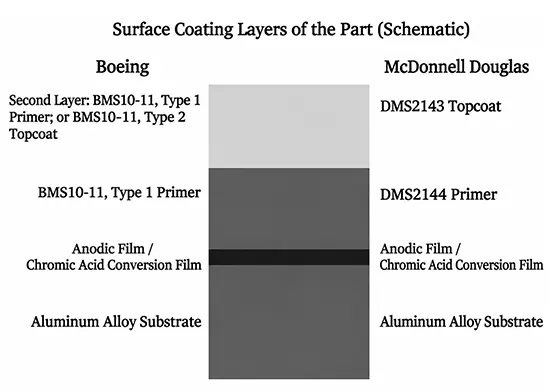
Chromic acid anodizing and Alodine conversion coating both provide surface protection for aluminum components. Major aircraft manufacturers widely apply these technologies to aluminum alloy parts.
Boeing and McDonnell Douglas use these surface treatment methods in their aircraft manufacturing processes. Figure 3 illustrates their aluminum component coating systems.
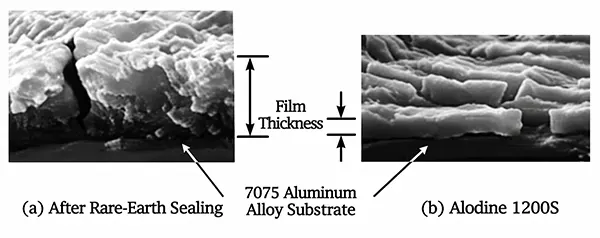
Electron microscopy reveals significant differences between chromic acid anodized films and Alodine 1200S chemical conversion coatings. Chromic acid anodizing produces a relatively thick oxide layer.
This thicker film provides greater surface hardness and suits the blade body’s operating requirements. In contrast, Alodine produces a thinner conversion coating with lower hardness enhancement.
However, the blade root operates inside the propeller hub and experiences relatively limited corrosion exposure. Therefore, a thinner conversion coating can provide sufficient corrosion protection.
Chromic Acid Anodizing
The blade body requires high surface hardness and strong corrosion resistance. Therefore, this study selects chromic acid anodizing for its surface treatment.
Chromic acid anodizing creates a thick, hard oxide film on aluminum and aluminum alloy surfaces. Hard anodized coatings can reach a maximum thickness of 250 μm.
The oxide film formed on pure aluminum exhibits microhardness values between 12,000 and 15,000 MPa. Aluminum alloy coatings generally achieve values between 4,000 and 6,000 MPa.
These hardness levels approach those of hard chromium coatings and provide excellent wear resistance under relatively low loads.
Chromic acid anodized films also exhibit relatively high porosity. This characteristic improves paint adhesion and makes the treatment suitable for painted propeller blade surfaces.
Chromic acid anodizing also offers advantages in preserving substrate fatigue strength. Compared with sulfuric acid anodizing, it produces a smaller reduction in fatigue performance.
Assuming an untreated material fatigue coefficient of 1.0, chromic acid anodizing reduces the coefficient to approximately 0.8. Sulfuric acid anodizing reduces it to approximately 0.6.
These comparisons support the selection of chromic acid anodizing for the blade body.
> Chromic Acid Anodizing Procedure
The researchers developed a chromic acid anodizing procedure based on the available processing equipment. The process begins after deoxidizing and rinsing the propeller blade.
First, stainless steel plates activate the chromic acid solution through an eight-hour test using the anodizing electrode.
The process maintains a chromic acid concentration of approximately 60 g/L. Solution temperature remains at 35 ± 2°C throughout anodizing.
Next, operators immerse the blade body in the chromic acid solution for approximately 60 minutes. They then disconnect the electrical supply and remove the blade.
Convective rinsing with distilled water removes residual solution and produces the required oxide film.
During anodizing, the voltage remains at 40 V, while current density stays at 20 A/m². Current gradually decreases as the anodized film develops.
After oxide formation, operators allow the blade to air-dry at room temperature for approximately 10 minutes. They then inspect its surface condition.
A sufficiently bright light source illuminates the entire blade surface. Inspectors examine all oxide-coated areas to identify visible defects.
Defective areas may display gray, brown, or dark-brown chromic acid stains. Any such defects require additional surface treatment.
The oxide film remains very soft before sealing. Therefore, operators must avoid touching the blade surface directly during this stage.
> Oxide Film Sealing Procedure
The sealing process resembles chromic acid anodizing but uses different temperature and immersion conditions. Operators again activate the chromic acid solution through an eight-hour test.
The sealing solution temperature increases to approximately 81–83°C. The blade remains immersed for 15–20 minutes.
This treatment seals and hardens the oxide film. Operators then rinse the blade through convection and allow the coating to stabilize.
The completed process produces a smooth, continuous oxide film with a uniform appearance. The coating also provides strong adhesion for subsequent painting.
Alodine Chemical Conversion Coating
Unlike the blade body, the blade root requires exceptionally high surface smoothness. Cold rolling produces a surface roughness not exceeding 0.381 μm.
Chromic acid anodizing may damage this carefully finished surface and increase its roughness. Excessive roughness accelerates sealing ring wear and creates potential lubricant leakage.
Furthermore, chromic acid anodizing involves electrical current. Poor process control may cause electrical discharge damage to the component surface.
The blade body has relatively generous repair tolerances, allowing technicians to correct certain electrical damage. However, the blade root has extremely limited repair allowances.
Electrical damage to the blade root may require scrapping the entire propeller blade. Such failures can generate substantial material and maintenance losses.
Alodine treatment avoids these disadvantages while providing the necessary surface protection. It preserves blade root smoothness and offers a safe, convenient, and efficient processing method.
After evaluating commonly available Alodine products, the researchers selected Alodine 1200S. This chemical conversion treatment matches the blade root’s specific surface requirements.
> Alodine 1200S Treatment Procedure
The treatment begins with thorough cleaning of the blade root surface. Operators remove grease, dirt, and other contaminants before applying the conversion coating.
Next, they prepare an Alodine 1200 solution with a concentration of 7.55 g/L. The process operates at room temperature.
Operators use a specially prepared cotton ball soaked in the solution to coat the blade root thoroughly. They maintain solution contact with the surface for approximately five minutes.
Finally, operators rinse the treated surface to remove residual chemicals. This procedure produces a suitable chemical conversion film while preserving surface smoothness.
Conclusion
Aircraft propeller blade bodies and blade roots operate under different environmental and mechanical conditions. Consequently, they require different surface treatment technologies.
Chromic acid anodizing provides the blade body with increased hardness, corrosion resistance, and paint adhesion. These characteristics help protect exposed blade surfaces against mechanical impacts and environmental damage.
Alodine 1200S provides suitable corrosion protection for the blade root without compromising its precision-finished surface. This treatment also reduces the risk of sealing ring wear and electrical damage.
Combining chromic acid anodizing for the blade body with Alodine 1200S for the blade root meets their respective requirements. Extensive practical work has confirmed the feasibility of this treatment strategy.