
Titanium alloys, with their outstanding properties such as high strength, low density, excellent corrosion resistance, and superior heat resistance, have been widely applied in aerospace, shipbuilding, heavy industry, and defense sectors.
However, titanium alloys also exhibit characteristics like low thermal conductivity, low elastic modulus, and high chemical reactivity, resulting in poor machinability.
During machining, heat dissipation is challenging, material springback is significant, and tool adhesion and wear are common, often resulting in surface chatter marks.
Furthermore, the material readily reacts with gaseous impurities like hydrogen and oxygen in the air, forming surface-hardened layers that further accelerate tool wear.
Consequently, machining titanium alloys imposes stringent demands on tools, cutting parameters, and processing methods, making it a difficult operation.
This paper investigates a machining process for high-precision, ultra-thin titanium alloy shell-type products.
Field testing has validated the feasibility and effectiveness of this process solution.
Analysis of Process Challenges
Titanium alloy thin-walled hemispheres are critical precision components in marine heavy-duty transmission systems.
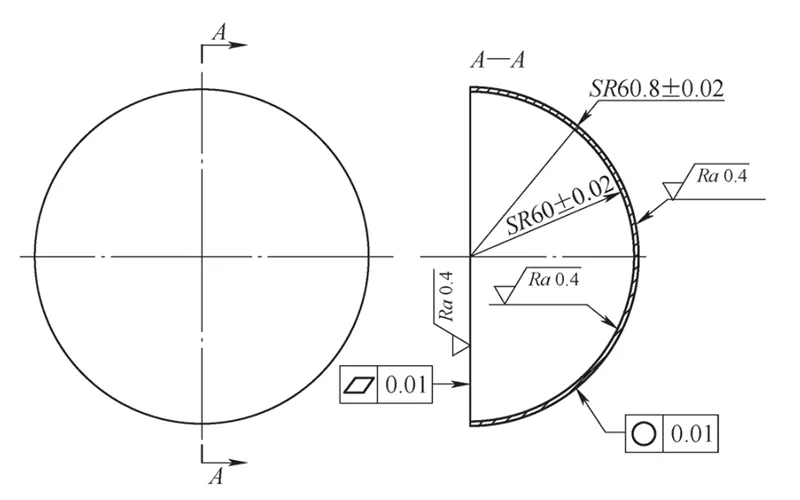
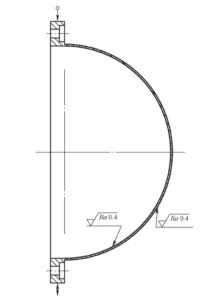
These hemispherical structures feature a wall thickness of only 0.8 mm, with an inner/outer wall surface roughness value of Ra = 0.4 μm.
Wall thickness tolerance is ±0.02 mm, while the outer wall roundness requirement is 0.01 mm, and the end face flatness requirement is 0.01 mm.
The schematic structure of the ultra-thin titanium hemispherical component is shown in Figure 1.
Due to the poor machinability of titanium alloys, machining demands stringent requirements for cutting tools, parameters, and methods, presenting significant processing challenges.
Conventional machining of ultra-thin titanium hemispheres often results in severe deformation, substantial dimensional deviations, and high surface roughness values.
These outcomes fail to meet design precision requirements while causing rapid tool wear and shortened tool life.
Process Design
Process Plan
The titanium hemispheres feature thin-walled structures with stringent machining precision requirements.
Combined with the poor machinability of titanium alloy materials, this presents significant manufacturing challenges.
To ensure processing quality, the team conducted multiple plan adjustments and practical validations.
This resulted in the determination of a tailored machining process plan and cutting parameters, along with the design of specialized lathe-type auxiliary fixtures.
To minimize deformation while ensuring machining accuracy and surface quality, the titanium hemispheres undergo a three-stage process: rough machining → semi-finishing → finishing.
Specific operations include: – Rough turning on both sides – Milling process grooves and drilling holes – Semi-finishing turning on both sides – Finishing turning on both sides – Polishing – Molybdenum wire deburring – Surface grinding. All turning operations are performed on a high-precision hard-surface CNC lathe (EU42).
Process Content and Cutting Parameters
(1) Rough Turning
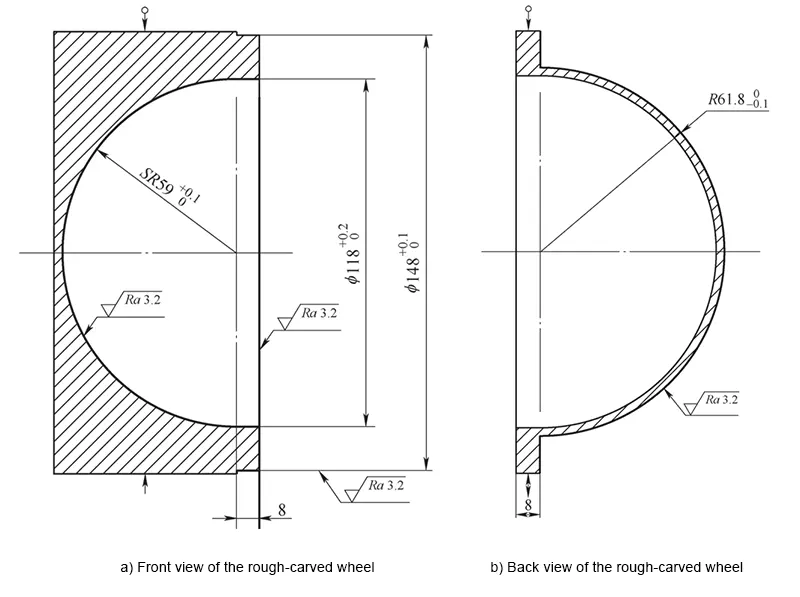
The product blank is a φ150mm TC6 bar stock. To facilitate clamping, an 8mm machining allowance is reserved during rough turning.
A 1mm machining allowance is reserved on both the inner and outer walls of the hemisphere.
The rough turning operations for both sides are shown in Figure 2.
Cutting parameters: – Cutting speed: 150 m/min – Depth of cut: 1.5 mm – Feed rate: 0.15 mm/r Tools used: 60° external turning tool and 35° internal boring tool.
Excessively high cutting parameters accelerate tool wear, while excessively low parameters compromise machining efficiency.
The cutting parameters provided in this process ensure minimal tool wear while maintaining high machining efficiency.
(2) Milling Process Grooves and Drilling
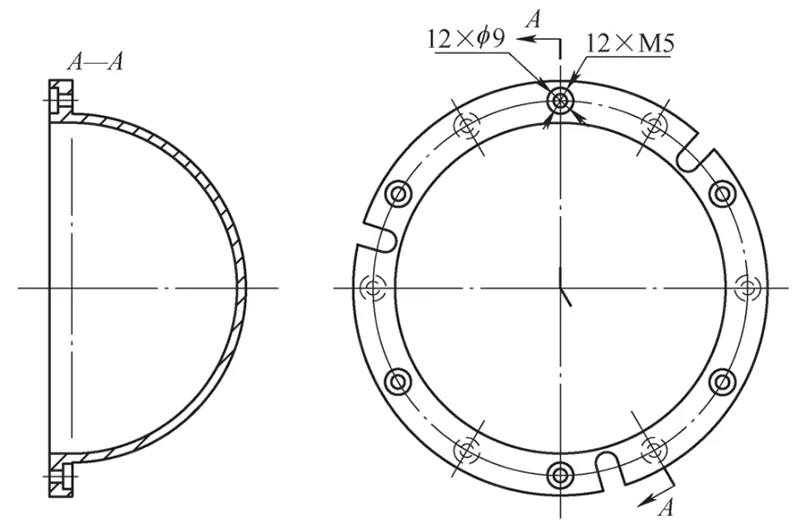
Three evenly spaced slots are machined on the process platform of the titanium hemispherical product to release internal stresses generated during processing and prevent deformation.
Additionally, six φ5.5mm countersunk process holes are uniformly distributed on both the front and back surfaces of the process platform for assembly with front and rear wheel tires.
The countersunk hole design ensures the end face remains machinable after tire assembly.
The milling process grooves and drilling operations are illustrated in Figure 3.
(3) Semi-Finish Turning
For front-side machining, combine the workpiece with dedicated lathe chuck 1; for reverse-side machining, combine the workpiece with dedicated lathe chuck 2, leaving 0.3mm allowance on both inner and outer walls.
Cutting line speed is 180m/min, depth of cut is 0.3mm, feed rate is 0.12mm/rev.
The cutting tools used include a 35° external round nose cutter and a 35° internal hole nose cutter.
The insert model is VCGT 160402 AS IC20, suitable for machining titanium alloy materials.
The insert tip radius is 0.2mm. A smaller tip radius enhances cutting edge sharpness, reduces cutting forces and heat generation, and better ensures machining accuracy.
The turning tool is matched to the product dimensions after rough turning on both sides, controlling the tool-to-product clearance between 0.02–0.04mm.
This ensures tight contact between the tool’s curved surface and the product’s surface.
During machining, the tool provides counter-support against cutting forces, preventing product deformation or chatter marks while maintaining dimensional accuracy and surface roughness.
(4) Finishing Turning
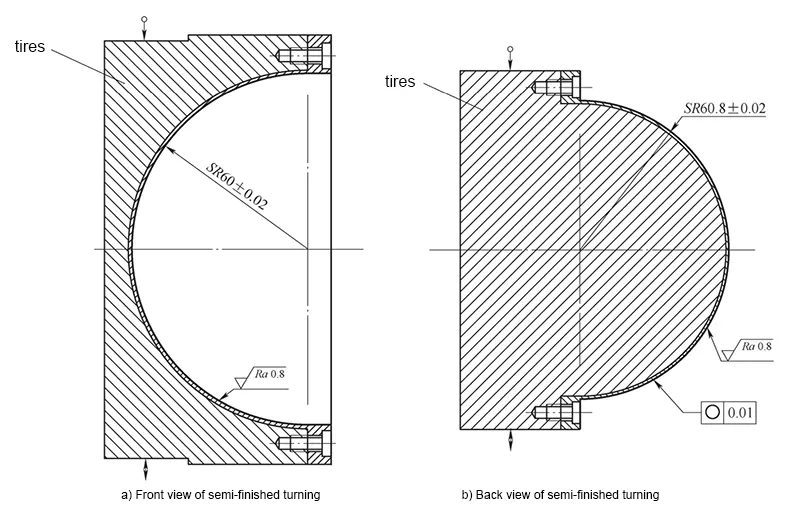
For front-side machining, the workpiece is paired with dedicated mandrel 3; for reverse-side machining, it is paired with dedicated mandrel 4 to achieve full wall thickness.
The mandrels are matched to the dimensions of the semi-finished product after front and back semi-finishing.
The clearance between mandrel and workpiece is controlled at 0.01–0.03 mm.
Cutting parameters include a cutting speed of 200 m/min, a depth of cut of 0.1 mm, and a feed rate of 0.06 mm/r.
Tools used include 35° external center tools and 35° internal center tools.
The facing and back-facing finishing processes are illustrated in Figure 4.
(5) Polishing
Brush polishing is employed to finish both the inner and outer walls, ensuring a surface roughness of Ra=0.4μm.
The polishing process is depicted in Figure 5.
(6) Molybdenum Wire Removal Process Table
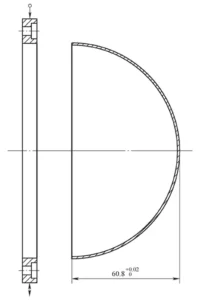
The product process table is removed using molybdenum wire cutting.
A simplified process flow diagram for molybdenum wire removal is shown in Figure 6.
(7) Surface Grinding
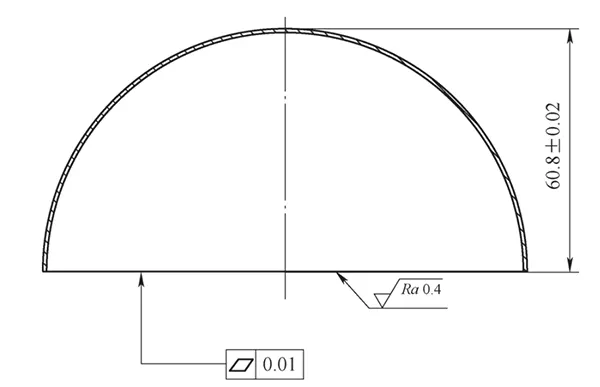
Ensures product length dimensions and end-face surface roughness.
The grinding process is illustrated in Figure 7.
This manual operation involves placing the titanium hemisphere on a grinding platform coated with abrasive paste.
The operator wraps the spherical surface in cotton cloth and repeatedly grinds the product end-face until it meets requirements for dimensional accuracy, flatness, and surface roughness.
Effect Verification
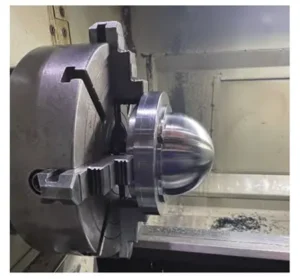
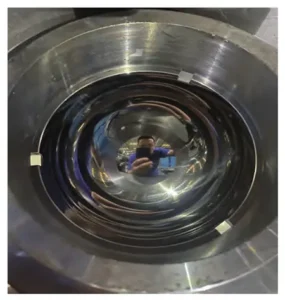
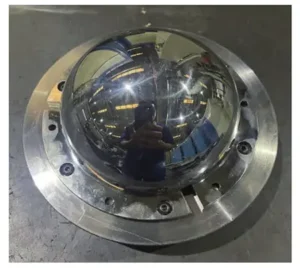
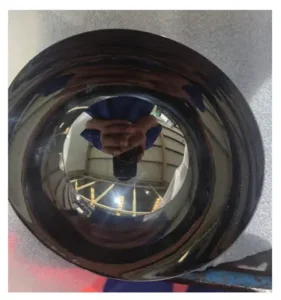
Field machining verification confirms that products processed using this method meet quality standards.
Dimensional accuracy, geometric accuracy, and surface roughness all satisfy design requirements, demonstrating the feasibility and effectiveness of this process.
Actual tires and workpieces are shown in Figures 8–12.

Conclusion
The titanium alloy thin-walled hemispherical component machining process proposed in this paper effectively reduces processing difficulty through the design of specialized turning tools.
This approach enhances product quality, stability, and machining efficiency while successfully addressing common issues such as deformation, dimensional deviations, poor surface roughness, low machining accuracy, and rapid tool wear during production.
Additionally, it provides a comprehensive process solution and reference cutting parameters for machining similar titanium alloy products.