
Die casting is a manufacturing process in which molten metal is rapidly injected into the cavity of a die casting mold under high pressure; the molten metal then cools and solidifies to form a casting.
There are two basic types of die casting: cold-chamber die casting and hot-chamber die casting.
In modern industrial production, die casting is commonly used to manufacture various metal parts. This process requires little or no metal cutting during production, resulting in high production efficiency and significant economic benefits.
Aluminum Alloy Die-Casting Production Process
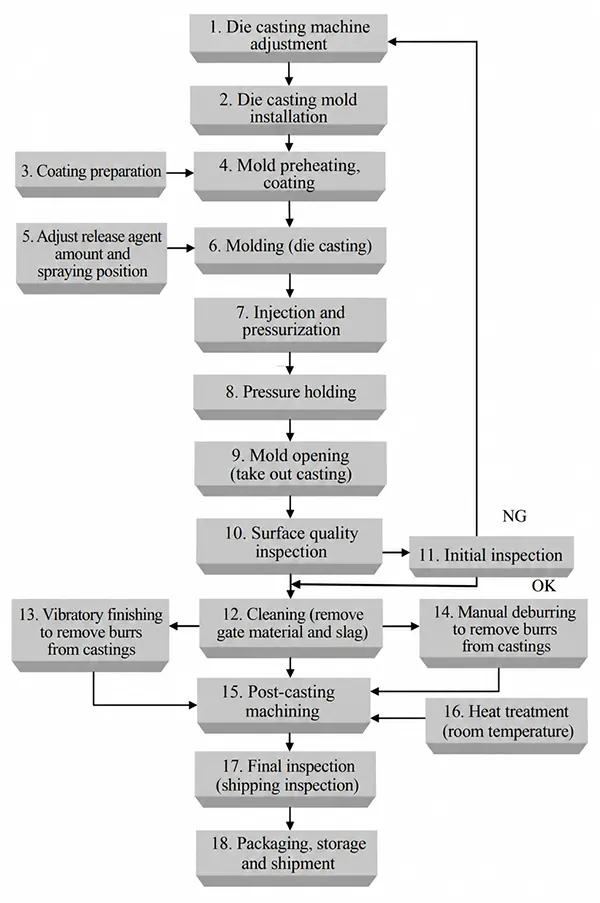
The aluminum alloy die-casting production process includes the following steps: die-casting machine setup, die installation, die preheating, coating, clamping, pouring and injection, holding pressure, mold opening, rough grinding, and fine grinding (see Figure 1).
Characteristics of the Die-Casting Process
The die-casting process integrates process factors such as temperature, pressure, time, and speed. It is fast and highly efficient, offering significant advantages in the parts manufacturing industry:
① The die-casting process can produce complex metal parts;
under high pressure, molten metal maintains high fluidity. Therefore, die casting is more widely used than other processes in the production of metal parts with complex shapes, sharp contours, and thin-walled, deep cavities.
② Die-cast parts feature high precision and excellent quality;
generally, the dimensional accuracy of die-cast parts ranges from IT9 to IT13, with surface roughness between Ra 0.8 and 3.2 μm. The parts have a dense microstructure, high strength and hardness, and excellent interchangeability.
③ The die-casting process offers high material utilization;
due to the high precision of die-cast parts, only minimal machining is required during production before assembly and use. Consequently, material utilization typically ranges from 60 to 80 percent, and blank utilization can even exceed 90 percent.
④ The die-casting process offers high production efficiency;
molten metal fills the mold rapidly, with short cycle times and fast solidification.
Hot-chamber die-casting machines perform 400 to 1,000 cycles per hour, while cold-chamber die-casting machines perform 80 to 100 cycles per hour.
Compared to other manufacturing processes, die-casting offers higher production efficiency and is better suited for high-volume production.
⑤ It is easy to meet specific performance requirements for localized areas of parts;
Advantages and Limitations of Die Casting
By incorporating positioning mechanisms into die-casting molds, inserts can be embedded, better meeting the specific requirements of localized areas of parts.
No manufacturing process is perfect, and die casting is no exception:
① Porosity and shrinkage porosity;
as molten metal rapidly fills the mold cavity and cools quickly—a process that takes only a very short time—if gases within the cavity cannot be expelled promptly, porosity or oxide inclusions will form in the die-cast part, affecting its quality.
② High costs make it unsuitable for small-batch production;
in die-casting, the three essential elements—the die-casting machine, the die-casting mold, and the molten metal—are all indispensable. Among these, the die-casting machine and the die-casting mold are relatively expensive, making the process unsuitable for small-batch production.
③ Limited types of die-casting alloys and restricted part dimensions;
due to limitations on the operating temperature of die-casting molds, the alloys currently suitable for die-casting primarily include aluminum alloys, zinc alloys, copper alloys, and magnesium alloys. Additionally, due to the size limitations of die-casting machines and molds, it is not possible to die-cast large parts.
④ The service life of molds is relatively short;
due to technical limitations, cracks, brittle fractures, and corrosion frequently occur during the use of die-casting molds, significantly shortening their service life.
Analysis of Factors Contributing to Die-Casting Mold Failure
The primary forms of die-casting mold failure include: cracking, crazing, splitting, wear, and
erosion. The factors leading to these phenomena are mainly as follows:
Intrinsic defects in the mold manufacturing materials
The quality of die-casting mold materials has a significant impact on the service life of the mold.
Inclusions in the mold material are the primary cause of cracks. When the size of these inclusions exceeds a critical threshold, the fatigue strength of the die-casting mold decreases as the particle size increases;
The rate of decline in fatigue strength is directly proportional to the cube of the inclusion particle size. During the die-casting process, the die is subjected to alternating rapid cooling and heating, making it highly susceptible to cracking and brittle fracture.
Therefore, when selecting die materials, factors such as resistance to thermal fatigue, thermal stability, and toughness must be fully considered.
Effects of Residual Stresses
Die-casting molds operate under harsh conditions. During the die-casting process, molten metal enters the mold cavity; due to spatial constraints within the cavity, tensile forces are generated at the undercuts.
As the mold temperature gradually rises under the influence of the molten metal’s temperature, the mold expands thermally, generating compressive stresses on its surface.
After the casting is removed, the mold undergoes cooling, causing it to contract and generate tangential tensile stresses.
Die-casting molds are subjected to the combined effects of internal and external stresses.
The interaction and continuous accumulation of these forces lead to the formation and progressive deepening of cracks in the mold.
Unreasonable Structural Design
An unreasonable casting structure design directly affects the service life of die-casting molds. For example:
① An unreasonable draft angle design can cause core pull, which easily leads to scratches when removing the part after the mold opens;
② An unreasonable casting structure design not only results in uneven wall thickness but also creates thin cross-sections within the mold, which are often the primary cause of early mold cracking.
Non-Compliant Operating Procedures
Non-compliant operating procedures during the production process are also a significant factor affecting the service life of die-casting molds. For example:
① Failure to preheat the mold or setting the preheating temperature too high; excessive preheating temperatures can affect the yield strength of the cavity surface material and reduce the mold’s resistance to thermal fatigue;
② Uneven application of mold release agent;
③ Failure to perform regular mold inspections and maintenance;
④ Non-compliant installation procedures.
Optimization Analysis of Die-Casting Molds
Selection of Materials for Die-Casting Molds
When selecting materials for molds, the current mainstream choice is H13 steel.
This material is forged from a blank using a forging process, followed by high-temperature quenching and tempering.
These treatments result in a rational, streamlined distribution of carbides within the steel, ensuring a more uniform distribution.
After forging, the steel achieves a hardness of 46–49 HRC, which significantly improves the mold’s wear resistance, corrosion resistance, and fatigue resistance.
Optimizing the Structural Design of Die-Casting Molds
A well-designed structure for die-casting molds can extend their service life. For example:
① Stepped cores can reduce the adhesion force of molten metal on the mold surface;
② A dual-core-and-cavity structure can reduce the impact of molten metal on slender cores;
③ Appropriately increasing the cross-sectional area of the internal runner can increase the molten metal flow rate and reduce the impact of molten metal on the die;
④ An integral overflow channel structure can effectively reduce die-cast part deformation and improve part quality;
⑤ Modular assembly reduces the overall rigidity of the cavity; this factor should be taken into account in the structural design of die-casting molds;
⑥ Designing insert structures at locations where cracks frequently occur in die-casting molds allows for the replacement of individual inserts rather than the entire mold when cracks appear during use, thereby extending the service life of the main mold body and effectively reducing costs.
Optimizing Machining Processes
Optimizing die-casting mold machining processes also has a significant impact on the service life of die-casting molds. This is specifically reflected in the following aspects:
① During die-casting mold machining, grinding generates a large amount of heat; therefore, grinding wheels with adequate cooling and good self-sharpening properties should be selected for fine grinding of die-casting molds to prevent surface cracking of the mold cavities caused by the machining process.
Additionally, hard-state milling of H13 steel can be used as an alternative to grinding to reduce production costs.
② Shot peening the surface of die-casting molds can effectively eliminate residual stresses in the surface layer caused by machining, alleviate thermal fatigue, and prevent the formation of cracks.
③ During the cutting of mold materials, performing rough machining first with medium pulse width and high peak current, followed by fine machining with short pulse width, can effectively reduce the pulse energy generated during cutting and prevent surface cracks in die-casting molds.
Heat Treatment Process
A rational and standardized heat treatment process can effectively extend the service life of die-casting molds.
Die-casting molds must undergo stress relief treatment before use; after the first stress-relief annealing, the quenching process is performed, and subsequent machining processes can eliminate deformation and cracks caused by quenching.
The temperature for stress-relief tempering of die-casting molds should be reduced by 30–50°C from the original tempering temperature.
The first stress-relief tempering should be performed after the mold has been used for 5,000 to 10,000 cycles; subsequent stress-relief tempering should be conducted at intervals of 15,000 to 20,000 cycles.
When treating the cores of die-casting molds, the hot oil first comes into contact with the core surface, which helps improve the core’s toughness and hardness.
Repeatedly turning the mold cavities in the hot oil improves and enhances convective heat transfer. Treating the surface of the die-casting mold cavities with nitriding or carbonitriding can effectively prevent erosion.
Surface Hardening Treatments for Die-Casting Molds
The surface of die-casting molds is most exposed to external factors. Surface hardening processes are simple, fast, and highly efficient, with minimal workpiece deformation.
They can effectively improve the fatigue strength, wear resistance, and corrosion resistance of die-casting molds. Common surface hardening methods include electrical discharge hardening, soft nitriding, and shot peening.
Electro-spark discharge hardening involves using a pulsed electrical circuit to cause periodic contact between the positive and negative terminals of the circuit, triggering air-gap discharges.
The resulting sparks and high temperatures deposit wear-resistant material onto the workpiece surface.
Under the combined effect of the sparks and high temperatures, the chemical composition and microstructure of the base metal are altered, forming a deposit layer that reduces surface erosion, prevents metal from seizing onto the mold surface, and extends the mold’s service life.
Standard Operating Procedures
During the production process, reasonable and standardized operating procedures are crucial for extending the service life of die-casting molds.
① Appropriate preheating temperature: During production, the magnitude of stress in die-casting molds is directly proportional to the temperature gradient; an appropriate preheating temperature can enhance the mold’s resistance to thermal fatigue.
② Proper use of mold coatings: Areas where the coating is not applied uniformly are often where erosion is most severe.
Therefore, when applying the coating, the spray pressure should be appropriately increased to prevent droplet coalescence and ensure as uniform a coating as possible on the mold surface.
③ Regular inspection and maintenance; component deformation and loose bolts in die-casting molds are major causes of premature mold failure. Regular inspection and maintenance can effectively extend the mold’s service life.
④ Strict adherence to installation guidelines; both before and during the use of die-casting molds, operators must strictly follow operating procedures, understand the mold’s basic structure and precautions for use, inspect and clean the mold surface before and after use, take rust-prevention measures during prolonged periods of non-use, and perform periodic stress-relief treatments on the mold.
Conclusion
As a highly efficient, non-cutting metal forming process, die casting is widely used in industrial production in China. Research on mold life is of great significance to the future development of the die casting industry.