
As the manufacturing industry evolves toward intelligent and automated processes, CNC lathes—as core equipment in mechanical processing—directly impact production efficiency through their machining performance.
In the mass production of standard parts, traditional machining methods suffer from significant efficiency bottlenecks.
Taking typical components such as bolts and nuts as examples, existing processes require repeated cycles of “machining—stopping—feeding.”
According to statistics, auxiliary time accounts for as much as 50% of such operations.
Traditional machining methods are not only inefficient but also physically demanding.
Operators must frequently open and close safety doors and adjust material positions, which not only increases labor costs but also poses safety hazards.
The risk of equipment maloperation rises with increased manual intervention, posing a threat to production safety and product quality.
Therefore, how to optimize the machining process of CNC lathes, reduce auxiliary time, and improve production efficiency has become an urgent issue in the manufacturing industry.
Many scholars have conducted extensive research in the field of automatic feeding technology, but each approach has its own limitations.
For example, the pull-type feeding mechanism proposed by Guo Hui (2020) uses hydraulic drive to transport bar stock, but it suffers from system complexity and high costs, making it difficult to widely implement;
Although the specialized fixture developed by Li Jincheng (2016) can achieve automatic feeding, it lacks versatility and struggles to adapt to materials of different specifications and shapes.
This study innovates upon existing pull-type feeder technology, aiming to achieve a more efficient and economical continuous processing solution through structural optimization and program control.
Analysis of the Current Situation and Problem Diagnosis
Analysis of Traditional Machining Models
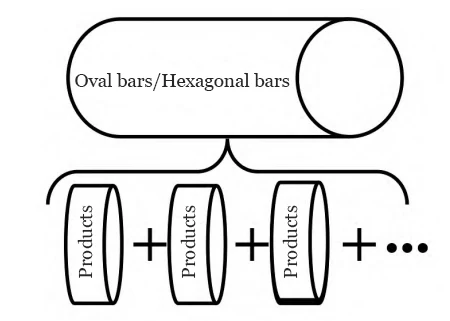
In the mass production of standard parts, raw materials typically consist of long bar stock (round or hexagonal), with a single piece capable of producing dozens of workpieces.
Figure 1 illustrates a typical scenario in the traditional machining process.
The long bar stock is retrieved from the storage bin and, after undergoing a series of steps such as chuck clamping and tool machining, is ultimately transformed into a finished product.
However, auxiliary time accounts for a significant proportion of this process, including material preparation, clamping adjustments, and machine downtime for feeding.
Traditional processing methods have significant shortcomings, which manifest as follows:
(1) Significant time loss: Under the traditional processing model, each product requires approximately 60 seconds of setup time, which is comparable to the actual processing time, resulting in low overall production efficiency;
(2) High labor intensity: Operators must frequently open and close safety doors and adjust material positions, which not only increases labor costs but also places a heavy physical burden on workers;
(3) Safety hazards: Increased manual intervention raises the risk of equipment maloperation, posing a threat to production safety and product quality.
Directions for Overcoming Technical Bottlenecks
To overcome the technical bottlenecks of traditional machining methods, we identified key areas for improvement using the FMEA (Failure Mode and Effects Analysis) method.
Through an in-depth analysis of each stage of the machining process, we found that the reliability of the feeding mechanism, the stability of the clamping system, and the response speed of the control system are the primary factors limiting production efficiency.
Key Areas for Improvement
(1) Reliability of the Feeding Mechanism:
The feeding mechanism serves as the critical link between raw materials and processing equipment; its reliability directly impacts the stability and continuity of the production line.
Traditional feeding mechanisms suffer from high failure rates and high maintenance costs, making technical improvements urgently needed.
(2) Clamping Stability:
When machining hexagonal stock, factors such as a small clamping surface area and uneven distribution of clamping force can easily lead to material deformation or dislodgement, affecting machining quality and efficiency.
Therefore, the clamping structure needs to be optimized to improve clamping stability.
(3) Control System Response Speed:
The control system serves as the “brain” of a CNC lathe, and its response speed directly affects machining efficiency and precision.
Traditional control systems suffer from issues such as response lag and insufficient control accuracy, necessitating optimization and upgrades.
System Design and Implementation
To address the issues and technical bottlenecks inherent in traditional machining methods, this study proposes an optimized solution for an automatic feeding system based on a material puller.
The system consists of mechanical and control modules and enables continuous automated machining of round and hexagonal bar stock.
Overall System Design
1. System Configuration
(1) Mechanical Module:
Includes a modified material feeder and a specialized collet.
The material feeder is the core component of the system, responsible for pulling raw materials out of the hopper and feeding them to the machining position.
The specialized collet is used to clamp materials of different specifications and shapes,
ensuring stability and precision during the machining process.
(2) Control Module:
Includes G-code programs and a timing control unit.
G-code is the programming language for CNC lathes, used to control the various steps and parameters during the machining process.
The timing control unit regulates the sequence of operations between the material feeder and the chuck, ensuring a smooth and continuous feeding process.
2. System Workflow
(1) The operator places the long bar stock into the hopper.
(2) Following instructions from the G-code program, the material feeder pulls the raw material out of the hopper and delivers it to the machining position.
(3) The chuck clamps the raw material, and machining begins.
(4) Once machining is complete, the chuck releases the material, and the feeder removes the machined section while simultaneously pulling out the next section of raw material for processing.
(5) Repeat the above steps until the entire bar has been machined.
Round Bar Processing System
The round bar machining system is one of the focal points of this study.
By selecting a universal bar feeder with a clamping range of Ø2–50 mm and combining it with G-code programs that optimize tool paths, continuous automated machining of round bars has been achieved.
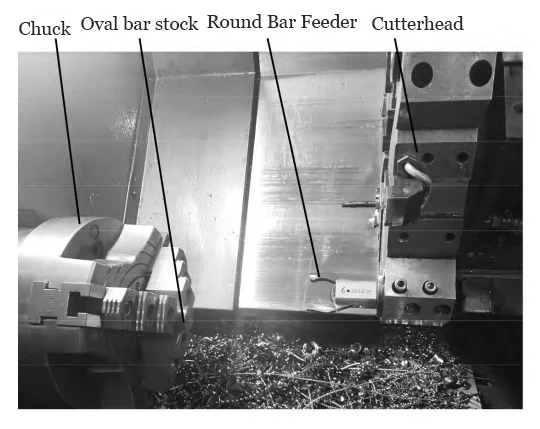
Figure 2 illustrates a typical scenario of the round bar machining system.
The bar feeder is installed in tool station 04; it uses movement commands to pull raw material from the hopper and deliver it to the machining position.
During the machining process, the control system regulates the tool’s path and speed according to the preset G-code program, ensuring machining quality and efficiency.
1. G-Code Program Description
Table 1 lists some of the key G-code programs used in the round bar machining system, along with their meanings.
These program instructions coordinate the movements of the bar feeder and the chuck, ensuring a smooth and continuous feeding process.
| No. | Program | Meaning |
|---|---|---|
| #5 | T0404 | Install the bar feeder at tool station 04 |
| #10 | G0X0Z10 | Move the bar feeder to the safety position |
| #15 | Z2 | Move the bar feeder to a position 2 mm away from the bar |
| #20 | G0Z-8 | The bar feeder grips the bar 8 mm |
| #25 | M11 | Release the chuck |
| #30 | G04X1 | Wait 1 second to ensure the chuck is released |
| #35 | G0Z31 | The bar feeder moves the bar out 31 mm |
| #40 | M10 | Clamp the chuck |
| #45 | G04X2 | Wait 2 seconds to ensure the chuck is clamped |
Table 1 Program Description
2. Tool Path Optimization
To improve machining efficiency and quality, this study optimized the tool paths.
By reducing unnecessary idle travel and optimizing cutting parameters, machining time and tool wear were reduced.
At the same time, high-precision sensors were used to monitor tool position in real time, ensuring stability and accuracy throughout the machining process.
Improvements in the Machining of Hexagonal Workpieces
The machining of hexagonal workpieces is another challenge in this study.
Due to the unique shape of hexagonal workpieces, conventional pullers struggle to grip and transport them directly.
Therefore, in this study, the pullers were upgraded and modified to meet the machining requirements of hexagonal workpieces.
1. Upgrade and Modification Plan
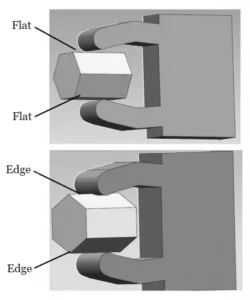
To address the unique shape of the hexagonal workpiece, this study involved welding a semicircular clamping sleeve onto each claw of the workpiece puller.
These sleeves can simultaneously grip all six edges of the hexagonal workpiece, thereby increasing the clamping area and stability.
Figure 3 illustrates a comparison of the clamping conditions before and after the upgrade.
By adding the semicircular sleeves, the clamping area increased by 300% (theoretical calculation), and the distribution of clamping force became more uniform, preventing material deformation.
Additionally, the semicircular sleeves can adapt to hexagonal workpieces of different specifications, enhancing the system’s versatility and flexibility.
2. Advantages of the Modification
(1) Contact area increased by 300% (theoretical calculation): Clamping is more stable, preventing material deformation;
(2) Uniform distribution of clamping force: Improved machining accuracy and efficiency;
(3) Adaptability to hexagonal workpieces of different specifications: Increased the system’s versatility and flexibility.
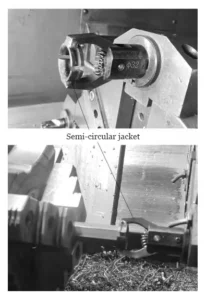
The improved structure is shown in Figure 4, where the semicircular sleeve is welded to the clamping jaws to form a complete clamping mechanism.
During the machining process, this mechanism can securely clamp the hexagonal workpiece and feed it to the machining position, ensuring machining quality and efficiency.
Experimental Validation and Benefit Analysis
To verify the feasibility and effectiveness of this study, M12 nuts were selected for batch processing tests.
The experimental results show that, compared with traditional methods, this approach achieves significant improvements in terms of cycle time per piece, labor intensity, and equipment utilization.
Table 2 lists the comparative data between the traditional method and this approach in the experiment.
It can be seen that this approach reduces the cycle time per piece from 120 s to 65 s, a decrease of 45.8%; labor intensity is also significantly reduced; and equipment utilization increases from 52% to 89%, an improvement of 71%.
These data fully demonstrate the feasibility and effectiveness of this study.
| Indicators | Traditional Methods | This Plan | Increase Rate / % |
|---|---|---|---|
| Piece-rate cycle time (s) | 120 | 65 | 45.8 |
| Workload | High | Low | — |
| Equipment utilization rate (%) | 52 | 89 | 71 |
Table 2 Data Comparison
Conclusion
This study focuses on addressing key bottlenecks—such as low machining efficiency and time-consuming production setup—that arise during the batch machining of standard fasteners, such as bolts and nuts, on CNC lathes.
To this end, we innovatively proposed and implemented an optimized automatic feeding system based on a bar puller.
The core of this solution lies in two aspects: first, the careful selection and configuration of highly adaptable bar pullers; and second, the independent development of dedicated control software.
This has successfully enabled a continuous, stable, and fully automated machining process for both round and hexagonal bar stock.
Following rigorous experimental validation, the implementation of this system has yielded significant results: the average processing time per bar has been drastically reduced by 45.8%, and overall production efficiency has surged by over 50%.
Moreover, this automation solution has effectively reduced operator fatigue, significantly enhanced operational safety, and improved human-machine collaboration.
The successful integration and application of the bar feeder technology on CNC lathes has not only overcome the technical limitations of traditional machining methods but has also paved a new and efficient path for the automation upgrade and transformation of CNC equipment.