
As a lightweight alloy, titanium alloys are widely used in the aerospace industry.
Characterized by high strength, corrosion resistance, and excellent thermal properties, they are extensively employed in core aircraft components such as ribs, frames, and beams.
With the rapid development of the aviation industry, the application of titanium alloys has become increasingly widespread.
In particular, the proportion of titanium alloys in the structural components of high-performance fighter jets has grown significantly.
For example, titanium alloys accounted for only 3% of the total weight in the F-16 fighter jet, whereas in the F-22—a typical representative of fourth-generation fighter jets—this proportion reached as high as 41%.
To meet the requirements for lightweight and high-strength aerospace equipment, titanium alloy structural components employ complex thin-walled, truss, and monolithic structural designs.
Materials with a metal removal rate exceeding 85% must be machined to form the final parts, posing significant challenges to machining efficiency and testing the rationality of tool selection strategies and process planning.
Narrow-slot deep-cavity structures are typical difficult-to-machine features in aerospace structural components.
When roughing cavities using large-diameter corn-type end mills or indexable high-feed end mills, the tool’s geometric limitations prevent complete material removal, resulting in suboptimal machining efficiency.
Conversely, using solid carbide end mills for layer-by-layer roughing leads to issues such as reduced tool life and low machining efficiency.
To address these issues, this study conducts a detailed analysis of methods to improve machining efficiency and tool life for typical deep-cavity TA7 titanium alloy structural components.
The analysis covers multiple aspects, including innovative machining strategies, optimization of cutting parameters, selection of tool parameters, cutting force analysis, and chip thickness control.
Through comprehensive process trials, the study introduces cutting parameters and machining strategies for high-dynamic milling technology to ensure stable machining during the roughing process of titanium alloy structural components.
High-Dynamic Rough Milling Process for Titanium Alloy Structural Components
Machinability of Titanium Alloys
Titanium alloys are typically difficult-to-machine materials; titanium’s thermal conductivity is approximately 1/14 that of aluminum, and the elastic modulus of titanium alloys is also relatively low (approximately 1/2 that of steel).
Consequently, they have poor rigidity and are prone to deformation during machining.
Additionally, the machined surface exhibits significant springback during cutting, which can easily cause adhesion and spalling wear on the tool’s rake face due to severe friction, further shortening tool life.
The high temperatures generated during the cutting process also compromise the surface integrity of titanium alloy parts, leading to a decline in geometric accuracy and work hardening, which significantly reduces their fatigue strength.
Beam-Type Structural Components
Long beam-type structural components are typical structural parts in aerospace equipment, as shown in Figure 1.
This part features a complex geometry, including thin webs, deep cavities, slanted rib tops, rib edges, and draft angles, making it challenging to machine in practice.
The blank is a sheet of TA7 titanium alloy with approximate dimensions of 1350 mm × 68 mm × 55 mm.
The initial mass of the blank is 41.9 kg, while the finished part weighs only 5.26 kg, resulting in a material removal of 36.64 kg and a material removal rate of 87.45%.
Among all structural features, the most challenging to machine is a narrow cavity: 260 mm in length, 48 mm in width, and 40 mm in depth, with a web thickness of only 2 mm.

Due to the limited space in such narrow, deep cavities, roughing tools such as corn cutters, high-feed cutters, and square-shoulder cutters struggle to perform efficient rough milling.
Traditional roughing methods are not only inefficient and result in short tool life, but also cause secondary compression of chips due to poor chip evacuation.
In severe cases, this can lead to tool breakage and workpiece scrap, thereby compromising machining quality.
To address these challenges, this paper employs a horizontal five-axis machining center in conjunction with a high-dynamic roughing strategy.
A comparative analysis is conducted against traditional layer-by-layer milling strategies, evaluating multiple factors including cutting force, tool life, and machining efficiency.
Selection and Basis for Machining Equipment
This paper selects a horizontal five-axis machining center for process testing and validation.
The milling spindle features an HSK-A100 interface, with a maximum output torque of 350 N·m, a maximum speed of 12,000 rpm, and is equipped with 3 MPa internal spindle cooling.
There are numerous advantages to selecting a horizontal five-axis machine tool.
A key benefit is the chip removal method: under the force of gravity, chips are rapidly removed from the machining area, ensuring machining accuracy, surface quality, and machining stability.
Optimization and Comparison of Machining Strategies
The key process factors in metal cutting include: tool selection, fixture selection, axial depth of cut (ap), radial width of cut (ae), cutting speed (vc), feed per tooth (fz), cutting force, tool wear, chip evacuation, and metal removal rate.
In actual production, cutting force, tool wear, and metal removal rate are critical factors in the machining process for improving machining efficiency and stability.
Advantages of High-Dynamic Milling Technology
This paper analyzes high-dynamic milling technology, which is suitable for machining parameters with large cutting depths, while the influence of cutting width is relatively minor.
With a large cutting depth, the material removal rate is higher, and chip formation is more effective.
This technology offers significant advantages over various other strategies, specifically manifested in: long tool life, the ability to achieve large cutting depths, high material removal rates, low cutting heat, and good process safety, while also meeting the roughing requirements for a variety of complex machining features.
High-dynamic rough milling produces small chips, enabling superior chip evacuation.
The brief contact time between the tool and the workpiece during high-dynamic rough milling allows for higher cutting speeds, significantly enhancing process stability and tool life, thereby achieving the goals of cost reduction and efficiency improvement.
Cutting Force Behavior in Different Milling Strategies
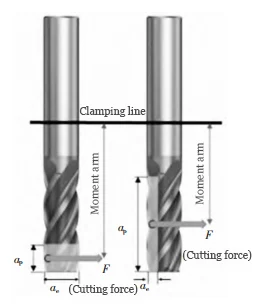
From the perspective of cutting forces: When using full-flute milling, cutting forces are concentrated near the tool tip, resulting in high force values at a single point.
Additionally, since the force application point is far from the tool shank clamping area, a long lever arm is formed, which can easily cause significant bending deformation of the tool, severely affecting machining safety and tool life.
When using shallow-cut milling, the cutter repeatedly selects specific points on the cutting edge for machining, while the remaining portions of the side cutting edge are underutilized.
This results in low machining efficiency when processing deep cavities and accelerates wear in the area near the cutting edge.
Mechanism and Structural Advantage of High-Dynamic Milling
The advantage of a high-dynamic milling strategy lies in its combination of deep cutting depth and narrow cutting width.
As shown in Figure 2, this strategy shifts the point of force application from the cutting edge to the middle of the rake face.
This change in the force application point brings the cutting force closer to the tool shank clamping point, shortening the lever arm of the milling operation.
Consequently, the overall rigidity of the tool is enhanced, thereby extending tool life and improving machining stability.
Cutting Force Experiment
Metal milling is essentially an energy-consuming process, and the magnitude of this energy depends directly on the cutting force; metal machining is, in fact, a process of controlling cutting forces.
During the cutting process, intense compression and friction occur between the tool, the workpiece, and the chips, resulting in wear and causing elastic and plastic deformation of the material, which in turn generates cutting forces.
Variations in cutting forces are one of the primary causes of tool failure (such as chipping or breakage).
Therefore, studying the patterns of cutting force variation is crucial for optimizing machining efficiency and extending tool life.
Cutting Power Relationship and Definition
Cutting power can be expressed as a function of the principal cutting force Fc and cutting speed v, with the calculation formula as follows:
Pc=Fcv/60 (1)
Where: Pc is the cutting power, in kW; Fc is the principal cutting force, in N; v is the cutting speed.
Experimental Design for Cutting Force Measurement
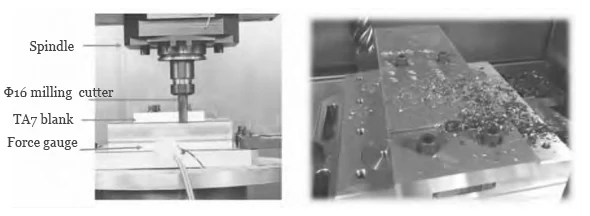
To verify the variation of cutting forces over time, a cutting force measurement experiment was designed for this study.
The experiment utilized a 16 mm diameter solid carbide end mill with an AlTiN coating manufactured by the German company V-CUT.
The test workpiece material was TA7.
Accurate measurement of cutting forces is fundamental to in-depth exploration of machining processes; without reliable cutting force data, it is impossible to monitor and analyze the machining process.
This experiment utilized a KISTLER 9255C piezoelectric cutting force transducer for measurement.
This instrument can accurately capture dynamic cutting forces, providing data support for analyzing the actual cutting process and evaluating process reliability, productivity, and repeatability.
The experimental setup is shown in Figure 3.
Comparison of High-Dynamic Milling and Layer Milling Behavior
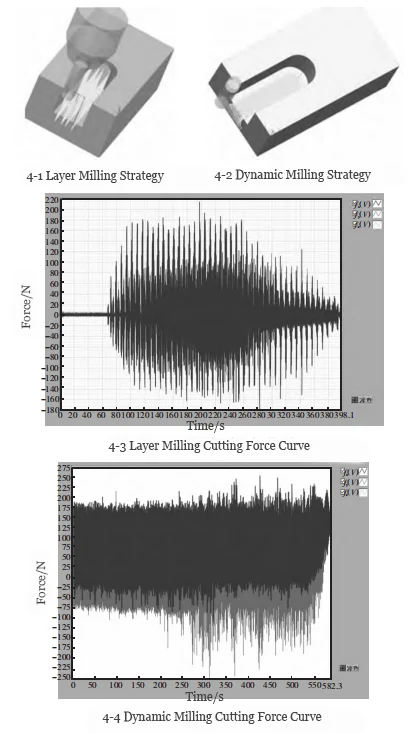
This experiment compares the cutting force characteristics of high-dynamic milling and layer milling.
The experimental results are shown in Figure 4, and the detailed data are recorded in Table 1.
The data indicate that in the layer milling strategy, the cutting forces in the X, Y, and Z directions remain stable; however, during the first full-depth pass, the tool is subjected to the highest load, which severely affects tool life.
The large amount of cutting heat generated during this process cannot be dissipated in a timely manner, leading to severe tool wear and low metal removal rates in layer milling.
In contrast, the cutting forces in the X, Y, and Z directions under the high-dynamic milling strategy exhibit intermittent and pulsed characteristics.
This is because the cutting edge remains in contact with the workpiece for a shorter duration in the dynamic milling strategy, thereby enabling higher cutting speeds.
This intermittent cutting creates favorable heat dissipation conditions, maintains a constant temperature in the cutting zone, and extends tool life.
At the same time, the stable chip thickness ensures smooth cutting forces, preventing tool chipping caused by sudden load changes.
Therefore, under the experimental parameters, both tool life and metal removal rate for high-dynamic milling were significantly improved.
The data in Table 1 shows that under similar cutting parameters, the metal removal rate for high-dynamic milling reached 29.25 cm³/min, which is 3.9 times that of layer milling (7.52 cm³/min), and the tool showed almost no wear after machining.
This indicates that dynamic milling with a large depth of cut and a small width of cut for roughing is a viable machining strategy.
| Strategy | Tool Diameter (mm) | Cutting Speed vₙ (m/min) | Spindle Speed n (r/min) | Feed per Tooth Fz (mm/z) | Feed Rate F (mm/min) | Radial Depth aₑ (mm) | Axial Depth aₚ (mm) | Cutting Force (N) | Torque (N·m) | Machining Efficiency (s) | Tool Wear | Metal Removal Rate (cm³/min) |
|---|---|---|---|---|---|---|---|---|---|---|---|---|
| Layer Milling | 16 | 80 | 1592 | 0.07 | 557 | 9 | 1.5 | 490 | 2.4 | 735 | Slight | 7.52 |
| Dynamic Milling | 16 | 80 | 1592 | 0.07 | 557 | 1.5 | 35 | 620 | 6.9 | 260 | None | 29.25 |
Table 1. Parameter Records for Layer Milling and Dynamic Milling
Analysis of Cutting Parameters and Tool Life
The appropriate selection of cutting parameters affects both metal removal rate and tool life.
Metal removal rate is a core indicator for measuring machining efficiency.
In dynamic milling, axial depth of cut is a key factor influencing cutting force, cutting edge length, cutting time, and tool wear.
Traditional machining approaches tend to prioritize machining safety by reducing cutting depth, but this results in low actual production efficiency.
To verify the impact of cutting depth, this paper conducted comparative tests using a high-dynamic milling strategy on TA7 stock.
Test conditions included a tool overhang of 38 mm, a tool linear speed of vc = 80 m/min, a feed per tooth of fz = 0.07 mm/z, and a radial cutting width of ae = 1.2 mm.
With all other conditions held constant, tests were conducted under two operating conditions: ap = 15 mm and ap = 30 mm.
The test results are shown in Table 2.
Comparison of tool wear: under the 15 mm cutting depth condition, edge wear was minimal; under the 30 mm cutting depth condition, edge wear was significant.
| Cutting Depth (mm) | Tool Diameter (mm) | Cutting Speed v (m/min) | Feed per Tooth fz (mm/z) | Radial Depth ae (mm) | Machining Time (min) | Tool Wear | Metal Removal Rate (cm³/min) |
|---|---|---|---|---|---|---|---|
| 15 | 16 | 80 | 0.07 | 1.2 | 20 | Low | 10.3 |
| 30 | 16 | 80 | 0.07 | 1.2 | 20 | High | 20.6 |
Table 2. Comparison of Cutting Depth in Dynamic Milling
The data shows that when the depth of cut increases from 15 mm to 30 mm, the metal removal rate rises accordingly from 10.3 cm³/min to 20.6 cm³/min, doubling the machining efficiency.
However, a greater depth of cut also means that a longer cutting edge is engaged in the cutting process, leading to an increase in cutting force and total cutting heat.
Consequently, tool wear under the ap=30 mm conditions is significantly greater than under the ap=15 mm conditions.
In summary, in actual production processes, selecting cutting parameters for high-dynamic milling with a large depth of cut can improve machining efficiency while keeping tool wear within a controllable range.
Analysis of Test Results
A comprehensive analysis of the test results indicates that the high-dynamic milling strategy significantly outperforms conventional layer milling in terms of both machining efficiency and process safety.
Among the various machining parameters used in high-dynamic milling, increasing the depth of cut accelerates tool wear, but the resulting improvement in metal removal rate is significant.
For example, increasing the depth of cut from 15 mm to 30 mm boosts machining efficiency by nearly 100%.
When designing machining strategies, the optimal balance between machining efficiency and tool life should be sought.
For the deep-pocket roughing process in actual TA7 production, selecting high-dynamic milling for roughing and employing larger cutting depth parameters can improve machining stability and efficiency.
Conclusion
This paper analyzes the challenges and characteristics of machining small cavities in TA7 titanium alloy structural components.
It comprehensively compares various strategies, including traditional layer milling, high-feed milling, and high-dynamic milling.
Considering multiple process factors such as cutting force, depth of cut, width of cut, tool path, tool life, cooling method, and metal removal rate, the high-dynamic milling strategy was selected as it improves machining efficiency and stability.
For efficient roughing of small cavities, the following improvements were implemented:
When machining enclosed small cavities, pre-drill holes with a U-drill first, then use the high-dynamic milling strategy for roughing; select dynamic milling parameters with a large depth of cut.
The axial depth of cut has a negligible impact on tool life; reducing the depth of cut may extend tool life by 20%, but it significantly reduces the metal removal rate, resulting in a decrease in machining efficiency;
This strategy has been validated in the customer’s production environment, demonstrating a stable production process and high product consistency.