
The nose cone is a critical component of a missile’s warhead, and its characteristics are crucial to the warhead’s performance and destructive capability.
The shape of the nose cone component is carefully designed to reduce aerodynamic drag and optimize the missile’s flight performance.
Its smooth surface and natural edge transitions help minimize drag, thereby increasing the missile’s range and speed.
Additionally, to reduce the missile’s overall weight, the nose cone component is often manufactured from lightweight materials such as carbon fiber composites and aluminum alloys.
These materials are not only lightweight but also possess high strength and stiffness, enabling them to meet the mechanical requirements of the missile during flight.
Nozzle components are typical examples of deep-hole, thin-walled parts.
Given the high costs associated with purchasing production equipment and cutting tools, this paper focuses on conducting dynamic cutting simulation analyses based on a machining simulation model of the nozzle component.
By utilizing data collected during the machining process with existing equipment, we optimized machining parameters and developed innovative vibration-damping cutting tools, thereby reducing production costs and improving production efficiency.
Optimization of the Machining Process for Air Cap Components
Process Analysis of Air Cap Components
Air caps are typical rotary parts. Their production process primarily involves turning, which is complex and involves numerous operations.
There are intricate constraints between various stages of the production process, and the technical specifications for these parts are extremely stringent.
Consequently, the machining of air cap components presents significant challenges.
First, the parts have thin walls and large machining allowances, resulting in low overall rigidity of the machining system; this lack of rigidity causes machining difficulties.
Second, the parts feature a conical design, which complicates clamping and further increases machining difficulty.
Third, this part involves deep-hole machining, with a hole depth-to-diameter ratio exceeding 20.
This makes the machining system highly susceptible to chatter during the process, which in turn leads to reduced machining quality and precision;
Fourth, the part requires high machining precision: the wall thickness tolerance must be uniformly controlled within 0.1 mm over a length of nearly 400 mm, and the surface of the external contour must be smooth with no tool marks, and the corners must have smooth transitions.
Optimization of the Machining Process
After identifying the machining challenges of the air cap component, it is necessary to determine the machining process.
In turning operations, common clamping methods for the component include three-jaw chuck clamping and single-jaw with a support clamping.
To address the processing challenges posed by the large machining allowances and susceptibility to deformation of the air cap parts, a strategy of separating roughing and finishing operations is adopted.
Material is gradually removed through alternating internal and external cutting.
Since the overall shape of the part is conical, roughing directly along the part’s contour would cause significant difficulties in clamping for subsequent operations.
Therefore, during the roughing stage, clamping positions are reserved near the end of the part and in the middle section.
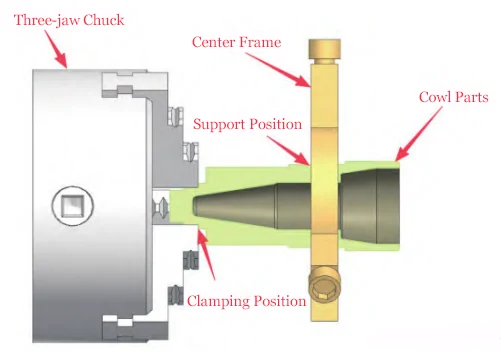
During the deep-hole finishing process, the reserved clamping positions are utilized to secure the part’s tail end with a three-jaw chuck, while a center support provides auxiliary support.
This clamping scheme effectively enhances overall rigidity and reduces vibration and tool deflection during cutting (as shown in Figure 1).
In the contour finishing process, the part is clamped using a three-jaw chuck to support the inner bore and a movable center to ensure clamping stability and reliability.
Optimization of Cutting Tools for Air Cap Components
Analysis of Cutting Tools for Air Cap Components
Air cap components feature complex internal structures, including arcs and steps, and it is essential to consider wall thickness while ensuring dimensional accuracy.
Due to limited machining space, deep-hole machining requires the use of tools with long overhang lengths to machine the inner surfaces of parts.
Since the overall rigidity of the tool shank is low in this machining environment, it is prone to causing system chatter, which in turn leads to reduced workpiece quality and precision, making it highly likely that the designed application standards will not be met.
Therefore, it is necessary to select the appropriate tool type based on the actual machining requirements of the part.
Tool Selection
1. Internal-coolant Bore Turning Tools.
Internal-coolant bore turning tools deliver coolant directly to the cutting edge via internal cooling channels, rapidly dissipating heat generated during the cutting process.
This effectively lowers the temperatures of both the tool and the workpiece while reducing friction between them, thereby decreasing cutting forces.
However, for bore-to-diameter ratios greater than 20, the shank strength of internal-coolant bore turning tools is insufficient, making them prone to vibration during machining, which can result in surface waviness.
2. Damping and Vibration-resistant Tool Shanks.
These shanks feature a built-in damping and vibration-reduction system that better withstands cutting forces, effectively suppressing vibrations during machining.
This reduces the impact of tool chatter on the workpiece surface and significantly shortens the machining cycle per part.
However, for wind cap components where the bore depth-to-diameter ratio exceeds 20, custom extended tool shanks are generally required.
These are expensive, making them too costly for small and medium-sized enterprises.
Vibration-Damping Boring Tool (Custom-Made Damped Tool Shank)
To ensure smooth machining of the inner bore of the air cap component, it is essential to eliminate vibration caused during machining and to maintain a continuous supply of cutting fluid.
During the machining of the air cap component, based on the part’s structural characteristics and process requirements, a vibration-damping boring tool with a length-to-diameter ratio greater than 20 was designed through theoretical derivation, simulation analysis, and experimental research, successfully completing the machining of the air cap component.
Stress Analysis and Parameter Optimization for the Machining of Air Cap Components
If cutting parameters are not properly controlled during the machining of air cap components, deformation of the parts may occur.
However, reducing cutting parameters to meet product quality requirements during production can lead to decreased machining efficiency.
Furthermore, there are many uncertainties in the machining of such components; factors such as the vibration frequency of the machine tool can affect machining quality.
Therefore, it is necessary to perform stress analysis, tool deformation analysis, and resonance analysis prior to machining to ensure the smooth progression of the machining process.
Finite Element Analysis of Air Cap Component Machining
Both the air cap component and the vibration-damping boring tool model were created using UG.
The air cap is a shell component with high precision requirements, made of 2A12-T4 aluminum alloy.
The vibration-damping boring tool is an extended-length damping tool, and its simulation was performed using ANSYS Workbench software.
1. Mesh Generation
Meshes were generated for both the air cap component and the tool.
Mesh size was controlled to ensure that the shell sections of the component had at least two layers of mesh, with uniform mesh sizes and smooth transitions.
2. Part Constraints and Loading
A fixed constraint was applied to the top of the air cap, while a compressive constraint was applied to the centering constraint area in the middle section of the air cap to simulate the constraints of a support fixture (center support).
Apply the cutting tool force at the point of maximum deformation on the farthest end of the collet part, and apply a combined force based on the different directions of the principal cutting force, feed resistance, and back force.
3. Tool Constraints and Loading
Apply a fixed constraint to the fixed end of the cutting tool and apply the tool reaction force at the cutting edge.
Select the limit operating condition with the maximum reaction force here, and apply a composite force based on the different directions of the principal cutting force, feed resistance, and back force.
4. Results Analysis
Through simulation analysis of various machining conditions for the air cap, the process adopts the principle of roughing followed by finishing and alternating between internal and external operations.
Deep-hole machining is performed using a three-jaw chuck + center support, ensuring controllable deformation of the air cap part and sufficient structural rigidity.
Based on finite element simulation and modal analysis of the cutting tool, the maximum deformation of the tool under extreme conditions is 1.5934 mm.
When machining under these conditions, cutting parameters should be appropriately controlled to reduce tool deformation.
The first six resonance frequencies of the tool are 273.82 Hz, 273.86 Hz, 690.98 Hz, 691.13 Hz, 1703.61 Hz, and 1703.9 Hz, respectively.
During machining, external input at these frequencies should be avoided as much as possible to prevent tool damage caused by resonance.
Optimization and Adjustment of Machining Parameters
In the machining of deep-hole, thin-walled parts, the appropriate selection of cutting parameters has a direct impact on part quality, production efficiency, and tool life.
This primarily involves cutting speed, depth of cut, and feed rate.
1. Cutting Speed
During deep-hole machining, excessively high cutting speeds increase the number of friction interactions between the tool and workpiece per unit time, accelerating tool wear and causing a sharp rise in temperature within the cutting zone.
This not only shortens tool life but also alters the microstructure of the machined surface, thereby reducing surface quality.
Conversely, excessively low cutting speeds reduce machining efficiency and result in higher surface roughness.
Taking the air cap component as an example: 2A12-T4 has high strength and good plasticity, making it prone to chip buildup during machining, which must be controlled by a reasonable cutting speed; however, the air cap component has poor rigidity, so an excessively high cutting speed can cause vibration and deformation, while a low speed will intensify friction between the tool and workpiece, increasing cutting forces.
Based on finite element simulation data analysis and actual machining verification, a cutting speed of 80–120 m/min is recommended for rough machining, and 150–200 m/min for finish machining.
2. Depth of Cut
Among the cutting parameters, depth of cut has the greatest impact on cutting force.
As the depth of cut increases, the deformation resistance and friction between the tool and the workpiece also increase, leading to a significant increase in cutting force.
This is particularly true in deep-hole machining, where the ratio of tool length to diameter is high and rigidity is poor; if the depth of cut is set too large, the tool is prone to breaking under the cutting force or may compromise the machining accuracy of the part.
Based on finite element simulation data analysis and verification through actual machining, when the cutting depth for the air cap component is set to 1.5 mm, the maximum deformation is approximately 0.093 mm.
Since this deformation is significant, a back cutting depth of 0.5 to 1 mm is recommended for rough machining, and 0.2 to 0.3 mm for finish machining.
3. Feed Rate
The feed rate is closely related to machining efficiency and surface quality.
If the feed rate is too high, cutting forces increase, which can easily cause tool vibration and workpiece deformation, resulting in reduced machining accuracy and increased surface roughness, making it difficult to meet high-precision machining requirements.
Conversely, if the feed rate is too low, machining efficiency decreases, thereby extending the machining cycle and increasing production costs.
Based on finite element simulation data analysis and the selection of cutting speed and depth of cut, a feed rate of 0.2–0.3 mm/r is recommended for rough machining of the air cap component, while a feed rate of approximately 0.1 mm/r is appropriate for finish machining.
Conclusion
During missile flight, the nose cone is subjected to high-speed airflow impacts.
To ensure the stability of the warhead during high-speed flight, it is necessary to refine the manufacturing processes for nose cone components.
By utilizing dynamic simulation and CAM toolpath optimization, we can optimize manufacturing processes, flexibly adjust tool configurations and cutting parameters, and ensure that the machining accuracy and surface roughness of the nose cone meet operational requirements, thereby providing critical technical support for the development of the equipment manufacturing industry.