
If the feed rate for an indexable round-nose end mill is set too high, it can easily cause the inserts to burn out. However, many people don’t realize that setting the feed rate too low can also cause the inserts to burn out.
The key lies in thinning the chip—whether a round-nose end mill cuts quickly or not depends entirely on whether this compensation is properly implemented.
What Is a Round-Nose Milling Cutter?
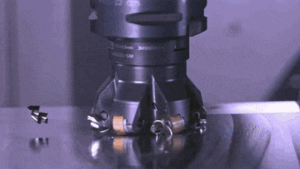
Round-nose milling cutters feature a circular cutting edge that is extremely robust and ensures a smooth cut.
They excel in 3D contouring, roughing, and semi-finishing, making them a staple tool in many machine shops.
Chip Thinning: An Inevitable Design Principle
By design, round-nose end mills inevitably produce chip thinning. Chip thinning occurs when the actual chip thickness is thinner than the programmed feed per tooth.
This happens when the rounded cutting edge penetrates the material with a contact area smaller than its radius—axially, radially, or both.
For round-nose end mills, there are typically two scenarios: the cutting depth is less than the insert radius, or the step width is less than the tool radius.
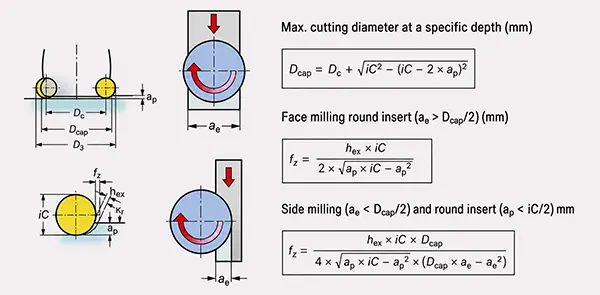
If no adjustments are made to address this issue, the cutting edge will be rubbing rather than cutting, which can result in the cutting edge burning out in mild cases or slowing down the cycle time in severe cases.
A round-nose end mill with a chip thickness of 0.1 mm may require 2 to 4 times the feed rate to achieve the optimal chip thickness.
How to Compensate: Feed Rate Adjustment
The key to compensation can be summed up in one sentence: Increase the feed rate so that the cutting edge can cut the chip thickness for which it was designed.
There’s no need to calculate the specific feed rate manually; the feed rate calculation feature in the machining calculator can do it for you.
Toolpath strategies are equally critical
The success of round-nose end mills depends on strategy, not just parameters.
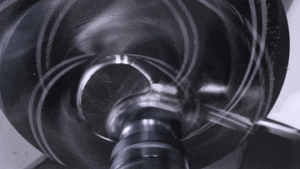
Use toolpaths that maintain constant cutting contact—such as dynamic milling and adaptive clearance—to ensure consistent radial contact.
Avoid abrupt changes in direction. Round-nose end mills perform best with three types of toolpaths: streamlined, deformed, and adaptive.
These strategies maintain stable contact, reduce tool pressure spikes, and extend insert life, allowing you to safely run at higher feed rates.
Long Overhang: Don’t Overlook Vibration Control
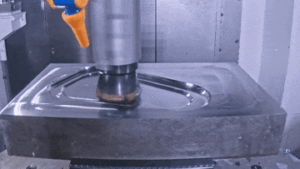
Another common challenge with round-nose end mills is long overhang.
For overhangs exceeding 4 times the tool diameter, any indexable end mill should incorporate vibration-dampening features, such as Sandvik’s Silent Line toolholders.
Reducing deflection and vibration is essential for maintaining cutting parameters and tool life. Toolholders of this type can make the difference between complete success and total failure.
Summary
Remember these three points: Don’t be afraid of high feed rates—what you should fear is friction. Always factor in chip thinning.
Optimize the toolpath first; blame the tool last.
Keep a close eye on your inserts: A shiny wear pattern indicates friction, not cutting. When programmed correctly, round-nose end mills are extremely powerful tools.