
A large-diameter, thin-walled stainless steel vessel from a specific project serves as the example in this article. The article briefly outlines the effective measures implemented during the manufacturing process. The focus covers three key areas.
These areas include preliminary technical planning, production preparation, personnel preparation, improvements to welding processes, and solutions to quality issues.
The vessel has dimensions of φ3800 × 12 mm, a total length of 14,400 mm, and is primarily made of 022Cr19Ni10.
Preliminary Preparations
Personnel and Facilities
This large-diameter, thin-walled stainless steel vessel is the first of its kind to be manufactured in the workshop.
The relevant personnel lack sufficient manufacturing experience, particularly given the detailed classification and limited compatibility of welding operation certifications.
Additionally, the production of stainless steel products involves strict cleanliness and anti-contamination requirements.
During the preliminary preparation phase, the branch first designated dual project leads for production and technical matters.
These leads were responsible for production scheduling and workforce allocation, as well as technical guidance, inspection, and process improvement, respectively.
Frontline operators were assigned to specific workstations and roles; however, they typically also participated in the manufacturing of other standard products during the production process.
A dedicated production zone was established, with barriers erected around the perimeter.
Open-flame operations involving non-stainless steel components were strictly prohibited within the production area.
Technical Preparation
Before production, technical staff, planners, and operators were organized to participate in multiple technical exchanges and training sessions.
Drawing on past experience in the manufacture of thin-walled vessels, they analyzed and discussed potential issues that might arise during the manufacturing of this vessel, along with preventive measures.
The assembly and welding sequence of various components and dimensional tolerance control.
Inspection standards for each process; welding methods and argon gas filling methods for restricted welding positions; the placement of the product roller stand;
And the selection of water inlet and outlet ports for hydrostatic testing.
For critical welding processes, operators were trained before commencement on welding quality standards, welding procedures, and requirements for completing welding records.
All operators were also trained on the proper completion of quality plans, process documents, and other record-keeping requirements.
Cylinder Manufacturing
Cylinder Section Manufacturing
Due to the large inner diameter and long developed dimensions of the cylinder sections, a two-stage semicircular assembly and welding method was adopted.
Furthermore, because of their relatively thin walls, the cylinder sections are prone to deformation under their own weight.
Supports were installed at the ends of the longitudinal seams to prevent deformation. Conventional assembly methods did not allow rotation of individual sections.
Flat welding methods made backside argon-shielded TIG welding difficult to perform. These conditions prevented effective control of welding distortion.
Consequently, during the preliminary technical preparation phase, the assembly method was adjusted.
Vertical assembly and cantilever welding were employed for the longitudinal seam welding of the cylinder sections, ensuring that the weld position was not affected by the section’s weight.
Additionally, after the semicircular sections were joined, fixtures were used to adjust and secure the gaps, preventing the cylinder sections from shifting during welding.
After the two longitudinal seams of the first cylinder section were completed, no significant welding distortion was observed at the weld location or in the surrounding area.
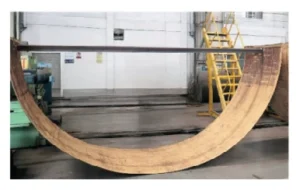
Cylinder Body Forming
After each cylinder section is formed, annular supports are used at the ends of each section to minimize self-deformation of the cylinder body during the manufacturing process.
During the welding of the first circumferential seam, the operator followed procedures by performing continuous welding with natural cooling.
After the entire seam was completed, dimensional measurements of the seam revealed deformation; while the deformation was at the lower limit of the allowable range, there was a possibility of exceeding the tolerance.
During the welding of the second circumferential seam, the operator used the lower limit of the specified welding current and an intermittent welding method.
Dimensional measurements taken after welding showed no significant deviation from pre-welding values, indicating that welding deformation was effectively controlled.
Head Circumferential Seam Welding
After the head circumferential seam has been assembled to the correct dimensions and secured, visual misalignment exceeding the tolerance limits is observed when the assembly is rotated.
Even after the shell section is rotated back, the assembly cannot be restored to its original dimensions, requiring a second assembly and correction.
This effectively amounts to reassembling the head circumferential seam, and the workload involved is significantly greater than that of the initial assembly.
To prevent circumferential seam deformation and dimensional deviations caused by rotation, the head must not be rotated after assembly and fixation.
Instead, the circumferential seam is fully position-welded and back-filled before rotation for the filler weld.
This ensures that the entire weld is back-filled using manual argon welding before rotation for the filler weld, effectively guaranteeing both the assembly dimensions and welding quality of the head’s circumferential seam.
Manufacture of the Skirting
The skirting is made of standard carbon steel, with a bottom plate thickness of only 25 mm; however, it features as many as 24 stiffening plates.
The fillet welds cause deformation in the bottom plate’s form and dimensions, and the extent of this welding distortion is unpredictable.
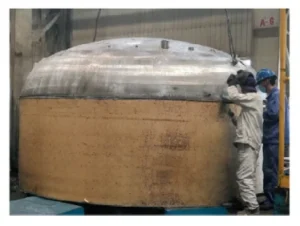
During the initial material preparation stage, the inner and outer diameters of the base plate were required to be increased by 10 mm each to allow for machining allowances.
After completion of the fillet welds on the base plate stiffeners, the base plate exhibited deformation in the horizontal plane. Some areas already reached the limit of the machining allowance.
The base plate also showed a maximum vertical height difference of 10 mm. This value exceeded the machining tolerance.
To address this, a post-weld heat straightening process was added to correct the deformation dimensions within the machining allowance range.
The plate was then machined on a lathe to achieve the design dimensions specified in the drawings.
Hydrostatic Testing
Due to the unique design of this product, the entire cylinder body has no large connection ports other than the end caps and manholes.
As a result, filling and draining during hydrostatic testing takes a relatively long time, and anti-corrosion measures are required during the testing process.
During filling, position the vessel so that the largest connection port faces upward, and add rust inhibitor; after hydrostatic testing, drain the vessel once through the head connection port.
Once the water level has dropped below the head connection port, rotate the vessel using a roller stand to position the body connection port at the lowest point for drainage, thereby achieving maximum drainage efficiency.
Since the first set of nozzles was sealed using stainless steel plugs made of the same material as the nozzles, the plugs were difficult to remove after hydrostatic testing and caused damage to the threads of some nozzles.
In subsequent hydrostatic tests, copper plugs were used to seal the nozzles; these were easy to remove after testing and did not damage the nozzle threads, effectively reducing the occurrence of thread damage.
Conclusion
A series of process improvements and quality control measures supported the manufacturing of this large-diameter, thin-walled stainless steel product.
Dedicated personnel supervised the entire production process. Strict quality control covered the longitudinal and circumferential welds of the cylinder sections. Engineers also optimized the product’s hydrostatic testing process.
These measures enabled the successful production of the first batch of thin-walled stainless steel products. The project also provided valuable experience for the future production of similar products.