
Valve bodies are the core control components in fluid systems, primarily used to regulate the direction, pressure, and flow rate of fluids.
They enable the flow or stoppage of media (gases, liquids, and powders) within piping and equipment, while providing precise flow control.
They are widely used in agricultural irrigation equipment, smart farms, water-saving irrigation systems, and other fields.
The feasibility, rationality, and sophistication of valve body machining processes directly impact production costs and product performance.
Based on long-term production experience and technological accumulation, the industry has established a relatively mature set of machining methods.
However, with the rapid development of Industry 4.0 and smart manufacturing, traditional machining processes can no longer meet modern industry’s demands for high precision, high efficiency, and high reliability.
Traditional processing methods rely heavily on the operational experience and professional skills of skilled workers, making it difficult to achieve large-scale standardized production and ensuring product consistency.
Therefore, the introduction of new technologies such as smart manufacturing, digital twins, and artificial intelligence has become a key pathway to enhancing the intelligence of valve body processing and driving industrial upgrading.
This paper focuses on how to enhance the intelligence of valve body processing by introducing these new technologies, thereby improving production efficiency and product quality.
Definition and Characteristics of Valve Bodies
The valve body is the primary component of a valve.
It controls fluid flow within a system and performs functions such as shutoff, regulation, flow diversion, backflow prevention, pressure stabilization, flow division, and pressure relief.
A valve’s sealing performance refers to the ability of its various sealing components to prevent medium leakage, and it is the most critical technical performance indicator for valves.
Valves used in fluid control systems—ranging from the simplest globe valves to various valve bodies employed in complex automated control systems—come in a wide variety of types and specifications.
Valve body materials include cast iron, cast steel, stainless steel, chromium-molybdenum steel, and plastic.
The characteristics of these materials determine the properties and application scope of the corresponding valve bodies: cast iron, due to its good castability and lower cost, is commonly used for valve bodies in general operating conditions.
Cast steel possesses high strength and toughness, capable of withstanding higher pressures and temperatures, making it suitable for medium- and high-pressure valve bodies; stainless steel, with its excellent corrosion resistance, is widely used in fields such as chemical processing and food processing where high resistance to media corrosion is required.
In addition to traditional valve body materials, efforts are being made to explore the use of new composite materials for valve body manufacturing.
For example, combining fiber-reinforced composites with a metal matrix yields materials that offer advantages such as light weight, high strength, and corrosion resistance.
By studying combinations of different fiber types (such as carbon fiber and glass fiber) and matrix materials (such as aluminum alloys and magnesium alloys), manufacturers can identify valve body materials suitable for various operating conditions.
This not only expands the application scope of valve bodies but also reduces their weight, thereby lowering transportation and installation costs.
Current Status of Valve Body Machining
1) Limited Adoption of Advanced Machining and Inspection Technologies
Modern machining technologies have not yet been fully adopted in valve body machining; most manufacturers still rely on traditional methods, such as using vertical lathes, radial drill presses, and conventional milling machines for mechanical processing.
Inspection tools also remain limited to conventional gauges, such as vernier calipers, micrometers, templates, plug gauges, and feeler gauges.
2) Inefficiencies in Traditional Machining Processes
Currently, most valve body manufacturers continue to use traditional machining processes, which suffer from issues such as numerous processing steps, frequent material handling, long machining times, and high tooling costs.
These factors directly hinder improvements in production efficiency and control over machining costs. Additionally, to ensure machining quality and precision, extra manual finishing steps may be required.
3) Quality Risks and Costly Rework in Conventional Methods
Valve body machining performed using traditional methods may result in scrap or substandard products.
To reduce waste and lower costs, rework is often performed at certain stages (such as weld repair and post-weld defect remediation), which consequently increases processing time and costs.
4) Integration of Smart Manufacturing and IoT Technologies
Introducing smart manufacturing technologies into valve body processing enables automation and intelligence in the manufacturing process.
For example, using industrial robots for loading, unloading, handling, and assembling valve bodies improves production efficiency and reduces human error.
Simultaneously, IoT technology can be used to connect machining equipment, enabling real-time data collection and analysis.
By monitoring and analyzing various parameters during the machining process (such as temperature, pressure, and cutting force), potential issues can be identified and addressed promptly, thereby improving machining quality and stability.
5) Application of Virtual Manufacturing for Process Optimization
Utilize virtual manufacturing technology to simulate and optimize the valve body machining process.
Before machining begins, establish a virtual model to perform simulation analyses of machining processes, tool paths, and clamping methods.
This allows for the prediction of potential issues during machining—such as tool interference or deformation—enabling adjustments and optimizations to be made in advance.
Consequently, this reduces trial-and-error costs during actual machining while improving efficiency and quality.
6) Early-Stage Implementation of Intelligent Technologies
Currently, although some enterprises have begun adopting smart manufacturing technologies, the overall implementation remains in its early stages.
For instance, the application of industrial robots in valve body machining is still primarily limited to material handling and loading/unloading, lacking intelligent machining control and quality inspection capabilities.
Furthermore, the application of digital twin technology in valve body machining is still in the exploratory phase, lacking systematic modeling and simulation analysis.
The application of artificial intelligence (AI) technology in valve body machining is also relatively limited, primarily focused on simple quality inspection and fault diagnosis.
In the future, it is recommended to further promote the application of technologies such as smart manufacturing, digital twins, and AI in valve body machining to enhance machining efficiency and product quality.
Improvement Measures and Solutions
By introducing industrial robots and intelligent control systems, we will automate and optimize the valve body machining process, thereby improving production efficiency and product quality.
Using digital twin technology, we will create a virtual model of the valve body machining process to simulate and optimize machining procedures, thereby enhancing machining efficiency and quality.
Through the application of artificial intelligence technology, we will implement intelligent monitoring and quality inspection of the valve body machining process, thereby improving product quality and production efficiency.
Analysis of a Typical Part
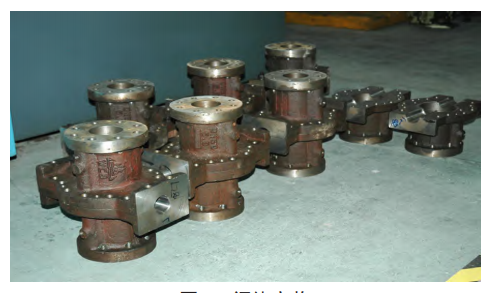
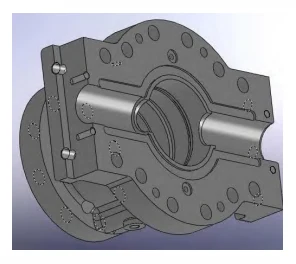
Taking the machining project for hydraulic control valve mechanical parts as an example, the physical valve body is shown in Figure 1, and the 3D model of the valve body is shown in Figure 2.
As can be seen from the figures, the valve body is characterized by its large size and the use of a limited range of equipment during the machining process.
In terms of technical requirements, the overall precision requirements are relatively low, but the level of operational skill required is high.
The machining processes are primarily concentrated in CNC milling, conventional milling, and fitting operations.
Due to tight deadlines, a short timeframe, a long sequence of processes (a total of 20 steps), and high assembly precision requirements (coaxiality error after valve body assembly must be controlled within 0.05 mm), some fitting operations present significant machining challenges.
These factors all contribute to the complexity of the machining process.
Key Functional Surfaces and Machining Requirements
The primary working or connecting surface of a valve body is its flange, which facilitates the transfer of media through connection.
Therefore, the machined holes must meet high standards for concentricity, roundness, and symmetry.
Additionally, when connecting two valve bodies, quality control during the machining process is critical to ensure that the two semicircles of the upper and lower halves form a complete circle.
To address this issue, the adoption of a reasonable positioning method is essential.
Structural Features and Positioning Strategy
In valve body components, holes serve a connecting or guiding function, while the outer circumference acts as the support surface, typically connecting to holes in the housing or frame via interference or transition fits.
The axes defined by the support or guide holes form the basis of the design, and these holes themselves serve as the positioning reference surfaces.
Figure 2 shows a typical valve body component made of carbon steel (WCC), which offers good mechanical properties and machinability.
Machining Challenges and Process Considerations
The part’s external dimensions are relatively large compared to its axial dimensions; its shape is irregular, dominated by
holes, and these holes require high machining precision.
Since the part has average rigidity, a reasonable machining process plan or parameter settings must be established during machining; otherwise, assembly clearance will occur, rendering the part unusable.
Improving Manufacturing Processes and Inspection Methods
1) Selection of Raw Materials:
The primary materials used for valve body components include cast iron, cast steel, stainless steel, carbon steel, plastic, and copper.
The main forming processes are casting or forging; depending on specific requirements, different methods are employed, with the primary principles being suitability for the intended application and cost-effectiveness.
2) Selection of Reference Points:
Valve body components are rotary parts consisting of end faces, bores, outer circles, grooves, and other features.
The flange is a critical component of valve body parts; it interfaces with other parts and serves as the design reference, so it is used as the machining reference.
Some valve body parts use the bore as the reference; the underlying principle is the same.
3) Use of New Equipment:
CNC milling machines (machining centers), bench drill presses, X8126 milling machines, vertical grinding machines, etc.
4) Cutting Tools:
Φ2 Type A center drill, Φ6 twist drill, Φ6.5 twist drill, Φ8.7 twist drill, Φ9.8 twist drill, Φ10 twist drills, Φ10.7 twist drills, Φ14 twist drills, Φ16 twist drills, Φ26 twist drills, Φ6×100 extended high-helix twist drills, Φ6×150 extended high-helix
Tapered Twist Drill, M10×1 Tap, M12 Tap, M16 Tap, Φ10 1:50 Taper Machine Reamer, Φ63 Face Milling Cutter, Φ10 Carbide Milling Cutter, Φ12 Carbide Milling Cutter, Φ10 Carbide Ball End Mill, etc.
5) Clamping Methods.
Valve body parts can be clamped using three-jaw chucks, four-jaw chucks, modular fixtures, or intelligent fixtures (which use sensors and digital algorithms to adjust clamping force and positioning accuracy in real time).
For parts requiring high precision, tapered mandrels can be used for clamping; during clamping, ensure coaxiality between the outer circular axis and the bore (mandrel) axis.
6) Process Steps.
The machining of valve body parts is fundamentally similar to that of shaft parts, and the alignment methods are largely the same, with the primary difference being the clamping method.
However, valve body parts have higher surface finish requirements, resulting in certain differences in machining methods.
The machining principles are: rough machining before finishing, primary operations before secondary operations, machining surfaces before holes, and machining reference surfaces first.
Conventional milling machines are used for rough machining, while CNC milling machines are used for finish machining (hole machining) to ensure the machining accuracy requirements of valve body parts.
At the same time, artificial intelligence technology can be applied to optimize machining parameters, such as cutting speed, feed rate, and cutting depth, to improve machining efficiency and quality.
Through machine learning algorithms, key parameters during the machining process can be predicted and optimized, reducing trial-and-error costs and improving production efficiency.
Based on the above principles, machining process guidelines for valve body components can be derived, leading to the formulation of corresponding machining procedures.
7) Inspection.
① Measuring Instrument Method:
Measuring instruments include calipers, micrometers, vernier calipers, height gauges, thread plug gauges, etc.
Applications: Direct measurement of linear dimensions such as outer diameter, inner diameter, and length, e.g., through holes in valve bodies and the depth of tapered holes.
Advantages: Simple operation, low cost, suitable for single-piece or small-batch inspection.
② Optical Instrument Inspection Method:
Measurement instruments include microscopes and projectors.
Applicable scenarios: Inspection of surface roughness and minute pore dimensions (e.g., valve stem deflection, surface cracks).
Advantages: High precision, suitable for analyzing complex surface topography.
③ Automated Measurement Method:
Digital image recognition technology can rapidly detect minute defects on the valve body surface, improving inspection efficiency and accuracy.
By using digital twin technology to analyze and process inspection data in real time, quality issues can be promptly identified and addressed, enabling traceability and monitoring throughout the product’s entire lifecycle.
Measurement instruments include industrial cameras, coordinate measuring machines (CMMs), laser scanners, and distance meters.
Applicable scenarios: Batch inspection of hole center distances, internal passage dimensions of valve bodies (e.g., non-contact measurement of hole alignment).
Advantages: High efficiency and precision; capable of generating 3D models for comparison with design data.
Typically, a combined approach using multiple inspection methods is adopted.
Key inspection areas include flange mating surfaces (which require high surface quality to ensure sealing, with a focus on perpendicularity and symmetry between rotating shafts), hole concentricity and roundness, and geometric tolerances of hole systems.
Online inspection and adaptive control are implemented during the machining process.
By installing sensors on the machining equipment, various parameters and quality indicators are monitored in real time during machining.
When machining errors exceed the allowable range, the system can automatically adjust machining parameters (such as cutting speed and feed rate) to achieve adaptive control.
This improves the stability of machining quality and reduces the scrap rate.
Green Machining Technologies and Smart Manufacturing Technologies
Green machining technologies are employed in the valve body machining process to minimize environmental impact.
For example, dry cutting is used in place of traditional wet cutting to avoid environmental pollution and resource waste caused by cutting fluids.
At the same time, waste generated during the machining process is recycled and reused to improve resource utilization.
Additionally, machining processes are optimized to reduce energy consumption, thereby achieving energy-saving and emission-reduction goals.
The introduction of smart manufacturing technologies enables the automation and intelligent control of the valve body machining process, thereby improving production efficiency and product quality.
Through digital twin technology, virtual models of the valve body machining process are created to simulate and optimize machining processes, enhancing both efficiency and quality.
Furthermore, artificial intelligence (AI) technology facilitates intelligent monitoring and quality inspection of the valve body machining process, thereby improving product quality and production efficiency.
Conclusion
In summary, the machining of valve body components is a typical example in the mechanical manufacturing process and is widely applied.
By applying proven processes to production and strictly controlling process parameters and quality, high-quality valve bodies that meet the demands of various operating conditions can be manufactured.
In the production of different valve bodies, customized machining process plans must be developed based on the structural characteristics, material properties, and application requirements of the valve body.
As manufacturing technology continues to advance, the integration of new and traditional processes will further elevate production standards.
New processes and equipment will open up greater opportunities for innovation and improvement in valve body machining, driving continuous progress in the valve manufacturing industry and meeting the ongoing demand for high-performance valves in industrial production.
At the same time, the application of new composite materials, along with the introduction of technologies such as smart manufacturing, virtual manufacturing, artificial intelligence, and green machining, enables intelligent monitoring and quality inspection during the valve body machining process, presenting new development opportunities for valve body machining processes.
These innovative measures not only enhance the level of intelligence in valve body machining processes but also provide valuable references for the machining of similar components.
In the future, with the continuous development of technologies such as smart manufacturing and artificial intelligence, valve body machining processes will become increasingly intelligent, automated, and efficient, providing strong support for industrial development.